Non-slip acrylic resurfacing, crack repair and precision line marking for courts across Parramatta, Penrith, Liverpool, the North Shore, the Sutherland Shire and Greater Sydney — every guide below ranked by what Sydney court owners are reading right now.
The lineup · ranked by reads & enquiries, last 30 days
01
The Basketball Feature Most read this month
YOUR COURT. YOUR COLOURS. YOUR ARENA.
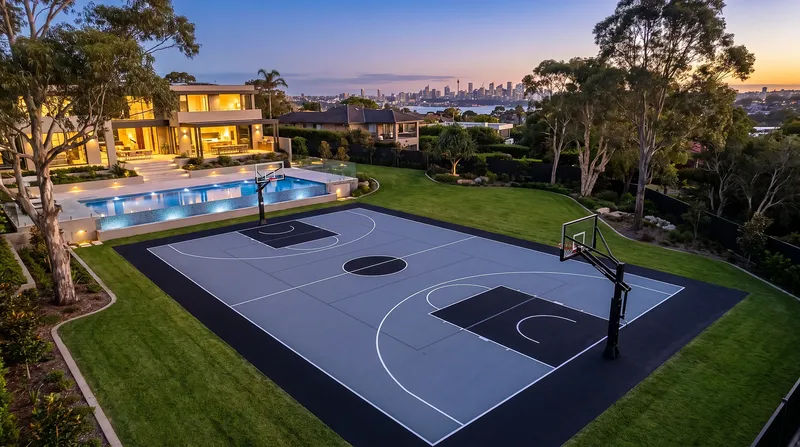
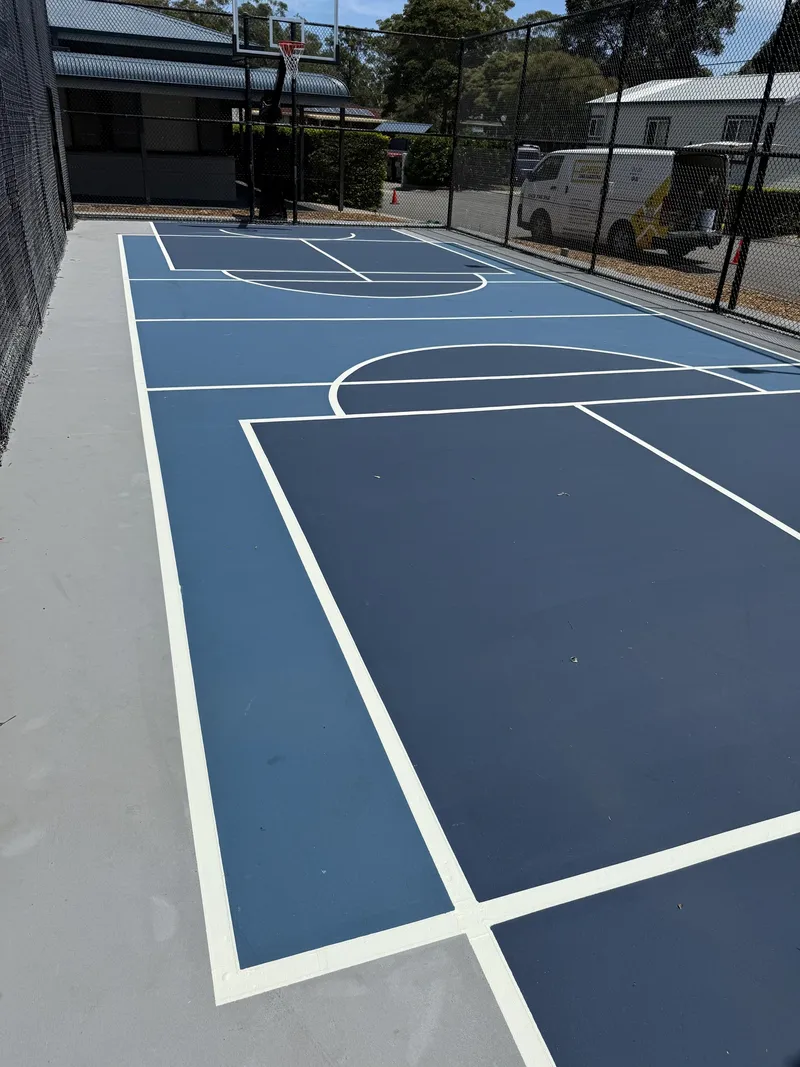
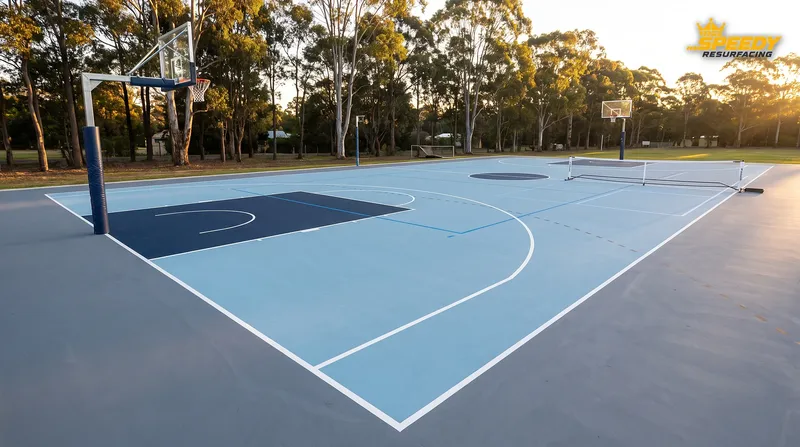
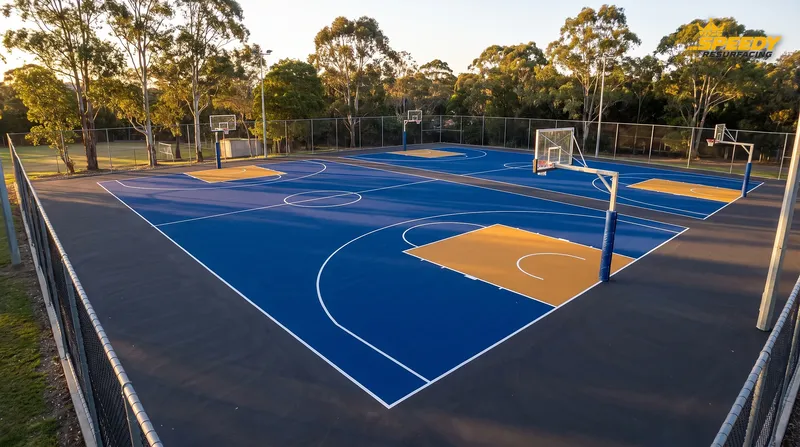
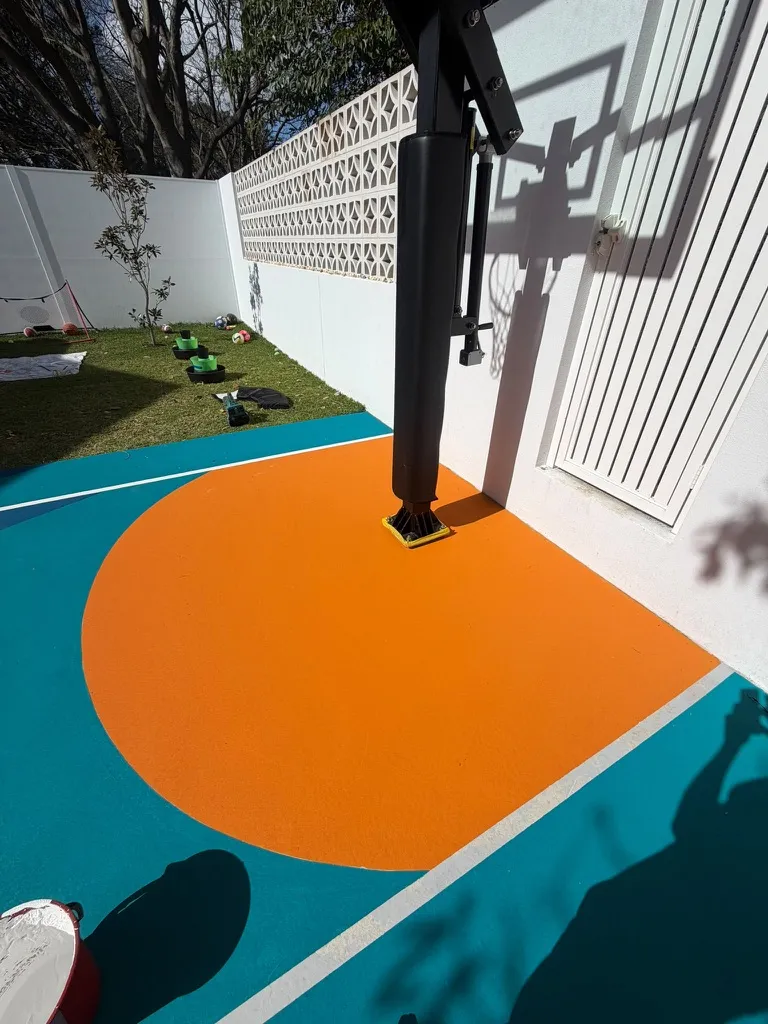
Five-colour custom basketball courts designed in 3D and delivered in Sydney backyards, schools and clubs — keys, three-point zones and logos in UV-stable acrylic that holds its colour through Western Sydney summers.
Preview your exact colours in the 3D Court Customiser before we quote
Backyard half-courts through to full-size school and club layouts
UV-stable acrylic built for Sydney heat and rain
Every line set out by the Speedy Line Marking crew
Western SydneyHills DistrictInner WestNorthern Beaches
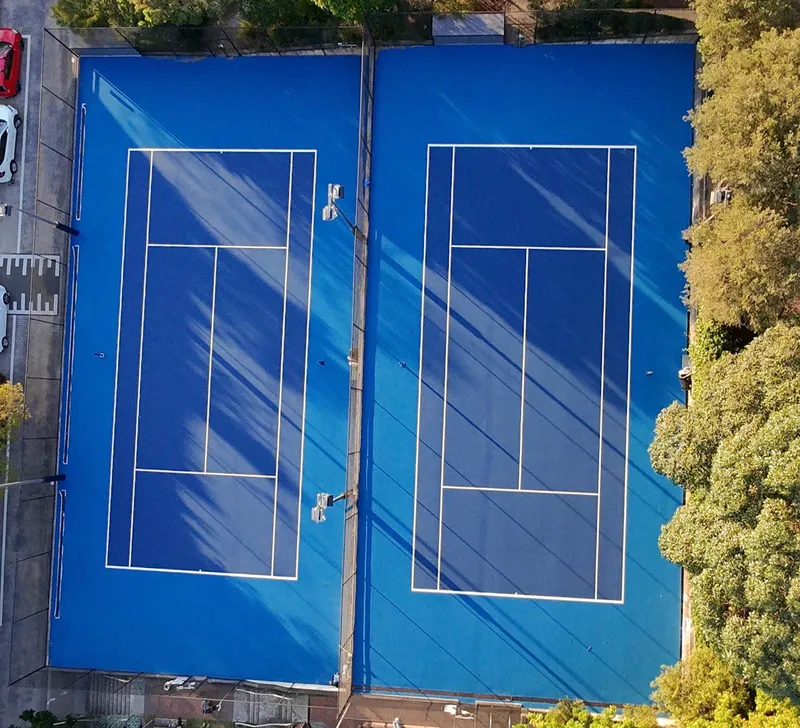
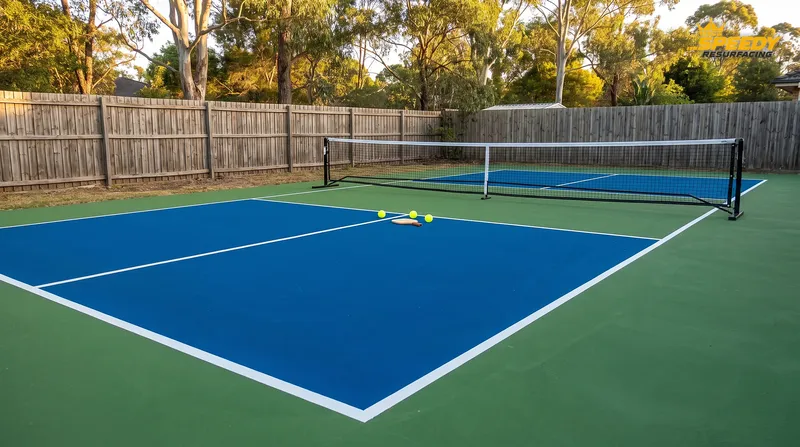
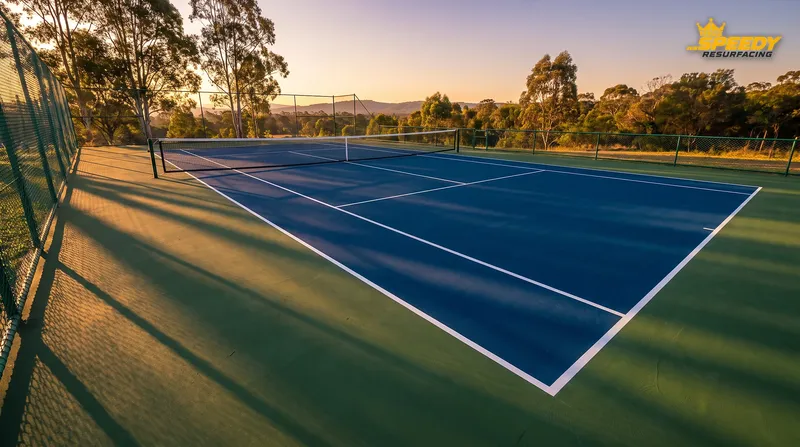
Club-grade tennis court resurfacing with consistent bounce, controlled pace and premium two-tone presentation — cracks and drainage fixed before a drop of colour goes down.
Cushioned or hard acrylic systems matched to your club or backyard
Consistent pace and bounce from an engineered surface texture
Crack repair and drainage corrected first, every time
Two-tone courts and surrounds for a photo-ready finish
7 Things We Assess Before Resurfacing a Sports Court
A high-performance court is far more than a fresh coat of colour. Before a single litre of acrylic goes down, Speedy Resurfacing runs a 7-point site assessment — substrate, cracks, coating history, water, contamination, sport and layout — because painting over an unexamined slab is a guaranteed recipe for failure.
Coatings applied over an unexamined substrate fail early — true surface performance starts with understanding the foundation.
Asphalt oxidises and ravels; concrete transmits vapour and carries laitance — each base needs a different priming and profiling protocol.
Cracks are triaged as hairline, stress or structural: resurfacing bridges minor movement but cannot fix active sub-base subsidence.
Incompatible or delaminating old coatings must be ground off, or the new acrylic will pull away with them.
Colour, branding and premium multi-layer acrylic from the Speedy Line Marking lineage — the guide to turning a tired slab into a court people photograph.
Custom colour, branding and court identity from concept to handover
Premium multi-layer acrylic systems engineered for Sydney's climate
Netball demands immediate traction on every landing — no slide, no second chance. When a school court polishes, cracks or pools water, adolescent knees and ankles pay for it. Inside the biomechanics of surface grip, the court-size variants that shape young players' fitness, and the 6-step system Speedy Resurfacing uses to make Sydney school netball courts safe again.
Netball's non-consecutive footwork rule demands immediate traction on landing — a weathered, gritless surface sharply lowers the coefficient of friction and loads adolescent ACLs and ankles.
School courts carry some of the highest daily footfall in Sydney: PE hub, recess zone and inter-school venue on one slab.
Silica-infused acrylic systems deliver AS 4586 slip resistance, remove micro-abrasions that cause friction burns, and buffer repeated impact on growing joints.
Court size changes the game: 7-a-side builds endurance, Fast5 half-courts build anaerobic power, 3v3 micro-courts build agility — one resurfaced slab can host all three with colour zoning.
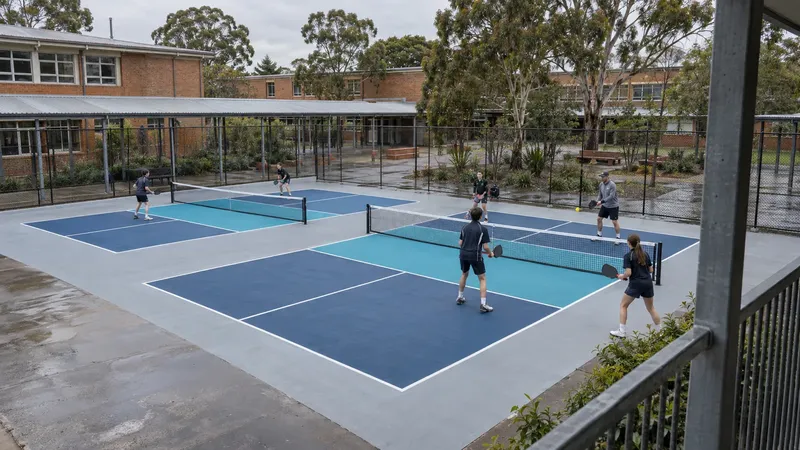
Pickleball Court Resurfacing for Educational Institutions in Sydney & NSW: Schools, Universities, TAFEs & Colleges
Pickleball is Australia's fastest-growing sport, and schools, universities, TAFEs and vocational colleges across Sydney and NSW are converting under-used courts into vibrant multi-sport pickleball hubs. Inside the foundation-first, 6-stage resurfacing system built for heavy student footfall, Australian UV and term-break scheduling.
A pickleball finish is only as resilient as the substrate beneath it — painting over a compromised school court guarantees peeling, bubbling and slip hazards.
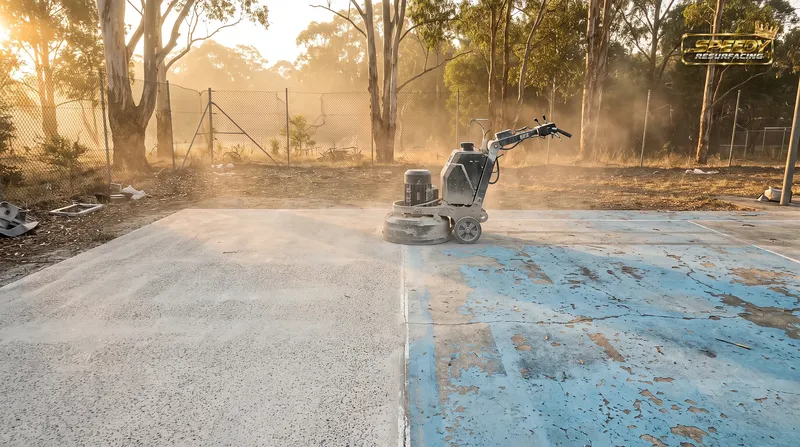
Foundation-first preparation: sub-base stabilisation, diamond-ground mechanical adhesion and the elimination of 'birdbath' pooling before any colour goes down.
Speedy Resurfacing's 6-stage system runs from diagnostic site assessment through structural repair to laser-guided regulatory pickleball lines.
One standard tennis court converts to up to four official pickleball courts — quadrupling PE participation without sacrificing existing infrastructure.
Beyond the Slab: The Complete Guide to Customising Residential Sports Courts in NSW
A technical blueprint for transforming aged residential concrete and asphalt into high-performance, showroom-ready multi-sport arenas — from geometric site diagnostics and diamond grinding to designer palettes and a five-sport line hierarchy on a single backyard slab.
A backyard slab becomes a showroom arena through five disciplined phases: diagnostics, substrate engineering, multi-layer resurfacing, designer aesthetics and geometric line marking.
Drainage is geometry: a 0.83–1.0% planar cross-slope, and any birdbath deeper than a $2 coin after 45 minutes of sun gets levelled.
Concrete is diamond-ground to CSP 2–3; asphalt is washed at 3500 PSI; cracks are V-routed and filled with flexible polyurea — never simply coated over.
The system is three layers deep: sand-filled acrylic resurfacer, two UV-stabilised colour wear coats, then a fine finish coat that locks in pigment.
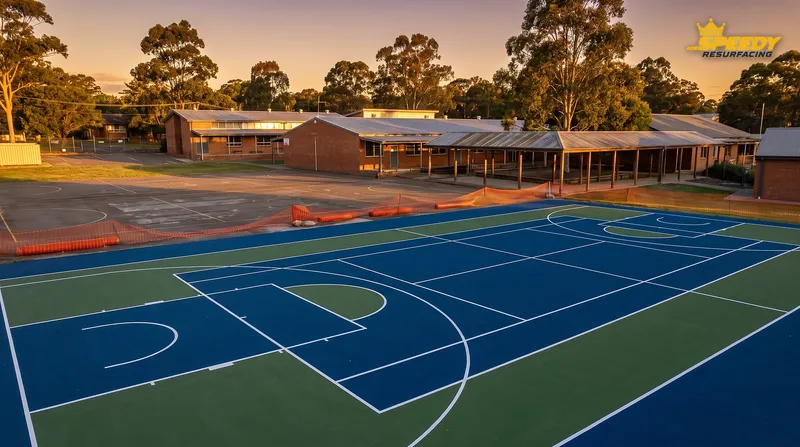
Multi-sport school courts resurfaced over the holidays by a Cm3-prequalified crew — netball, basketball and handball lines on one bright, non-slip slab, with zero disruption to the timetable.
Multi-sport overlays — netball, basketball and handball on one slab
Non-slip, low-abrasion texture that is kind on knees and elbows
Holiday-period scheduling with zero disruption to classes
Cm3-prequalified — WHS paperwork done before we arrive
Sydney's fastest-growing sport deserves a court that plays true — multi-layer UV-stable acrylic, silica-textured traction and kitchen lines set out to the millimetre. Tennis-to-pickleball conversions fit up to four regulation courts on one footprint.
Up to four regulation pickleball courts on one tennis court footprint
UV-stabilised acrylic that flexes with Sydney's heat and humidity
Kitchen, baselines and sidelines by Speedy Line Marking — zero paint bleed
Concrete or asphalt bases · 5–8 year lifespan
Inner WestNorthern BeachesNorth ShoreWestern Sydney
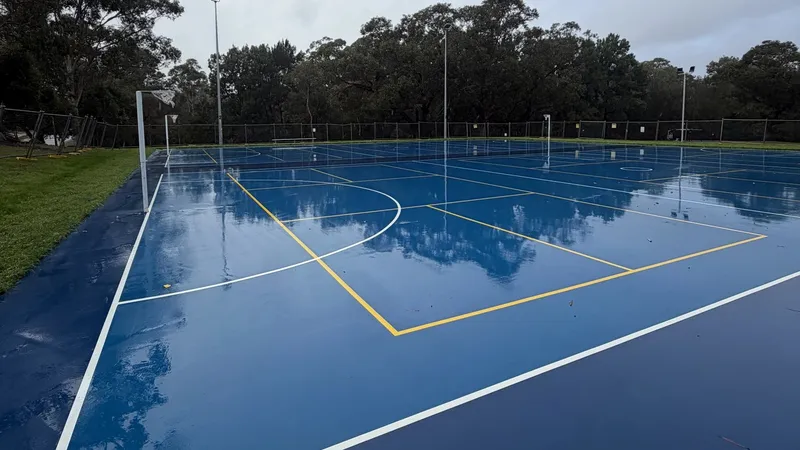
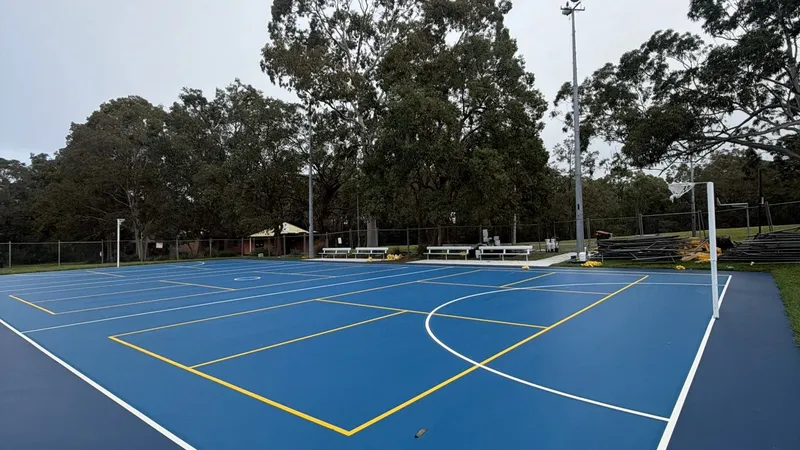
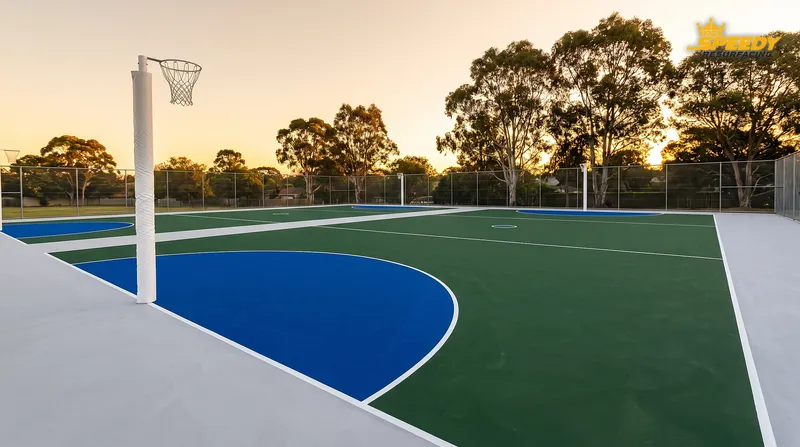
Netball courts across Sydney restored to regulation grade — non-slip texture that holds a hard stop, sealed cracks that stay sealed, and Netball Australia-compliant lines. Back in play in 3–5 days.
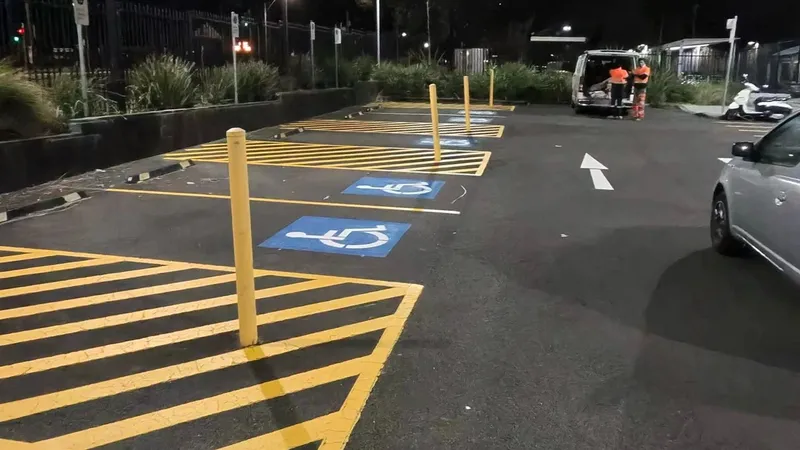
AS2890.6 accessible parking bays, non-slip pathways and inclusive recreation courts for SDA and NDIS providers — so the participant's day works from the moment they leave the vehicle.
AS2890.6 accessible bays, shared zones and ISA stencils by Speedy Line Marking
Non-slip, level pathways and courtyards for heavy wheelchair traffic
Inclusive recreation courts for NDIS participants
External Asset Maintenance Plans that keep sites compliant
Multi-Sport Court Colour Design: How to Balance Basketball, Pickleball, Netball, and Tennis Layouts
One slab, four sports, zero confusion. A successful multi-sport court relies on strategic colour contrast, visual zoning and a clear line hierarchy — colour fills first, then 50 mm white primary lines, a receding secondary shade, a dashed tertiary tone. This guide covers ball visibility by sport, school colours done right, dedicated versus shared layouts, ghost-line removal, how much footprint you really need, and planning the job in Merrylands and Western Sydney.
A two- or three-tone acrylic palette — playing zone, feature zones (keys, kitchens) and perimeter apron — establishes boundaries before any line is applied.
Choose surface colours for the ball: yellow pickleballs and tennis balls need cool, dark backgrounds (deep blue, slate grey, forest green); avoid yellow or lime-green coatings in pickleball zones.
Line hierarchy: primary sport in 50 mm solid white; secondary in a receding shade such as sky blue, soft yellow or light orange; tertiary in soft grey or red, or dashed segments.
Keep school and brand colours on the apron, run-off and centre logo — never inside the active playing zone.
Cracks, Low Spots & Worn Coatings: What Gets Repaired Before Court Resurfacing?
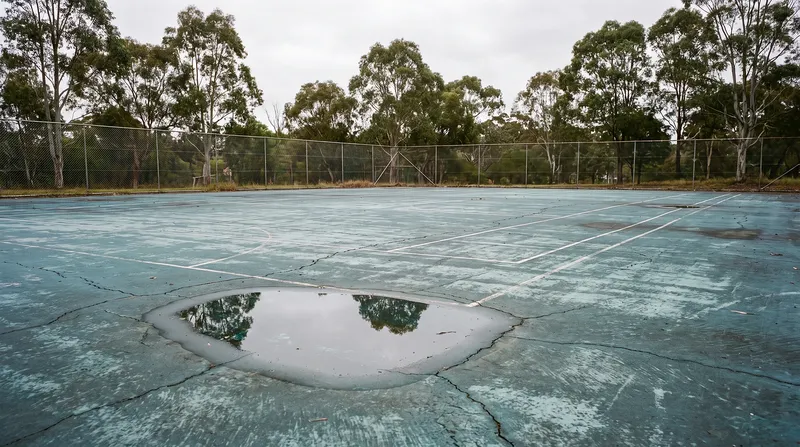
A professional court transformation does not start with fresh acrylic — it starts with engineering the foundation underneath. Here is the technical breakdown of every repair executed on a Sydney sports court before the colour coats and line markings go down: crack routing and flexible patching, the one-hour flood test and birdbath levelling, removal of unstable coatings, and substrate profiling.
Cracks let water into the sub-base; every one is routed to a clean V-groove, blown clear and filled with flexible silica-blended acrylic filler so it moves with the slab instead of pushing through the topcoats.
True expansion joints are never just painted over — they are cleared and sealed with elastomeric sealant that absorbs slab movement while staying watertight.
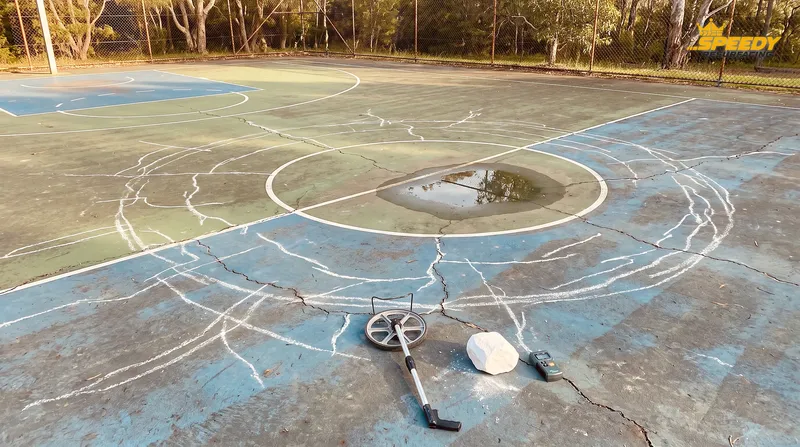
The one-hour flood test finds every birdbath: any pool deeper than a coin after 60 minutes is perimeter-marked and levelled with acrylic patch binder, feather-edged to zero.
Peeling, chalking, efflorescence and algae each have a specific corrective method — grinding, scarification, acid etching with vapour-barrier primer, or biocide and mechanical scrubbing.
Why Surface Preparation Determines the Quality of a Resurfaced Court
The colour coat is the part everyone sees — but a resurfaced court lives or dies on what happens before it. Grinding, pressure cleaning, crack routing, flood testing and priming account for roughly 80% of a court's long-term performance. Here is what elite preparation looks like, what the shortcuts look like, and how the Speedy method handles Western Sydney slabs.
Surface preparation accounts for roughly 80% of a resurfaced court's operational utility and lifespan — the colour coat is the last thing you see, not the thing that lasts.
Acrylic systems need a ground, porous, contaminant-free profile to bond; paint over smooth, dirty or flaking surfaces peels within months.
Cracks are V-cut and filled with flexible elastomeric acrylic binders so they move with Western Sydney's seasonal ground movement instead of reflecting through.
Birdbaths deeper than a two-dollar coin are found by flood testing and levelled with acrylic patch and silica mixtures before any colour is applied.
Schools, councils and homeowners resurface basketball courts for very different reasons — holiday shutdown windows, public-safety run-off and handover documentation, or a backyard squeezed between a fence and a retaining wall. This guide compares the three buyer groups, sets out FIBA full-court, half-court and custom compact dimensions, explains multi-sport line hierarchy, and lists exactly what a professional resurfacing quote must itemise.
Schools need holiday-window execution and wear resistance; councils need FIBA layouts with certified run-off and handover documentation; homes need custom footprints that respect fences, walls and setbacks.
A FIBA full court is 28 × 15 m with a minimum concrete footprint of about 32 × 19 m once the 2 m perimeter run-off is included.
A standard half-court is 14 × 15 m (or scaled to 10 × 12 m) with a full three-point arc, free-throw line, charge circle and key; custom compact pads run from about 6 × 8 m to 9 × 10 m.
A backyard court does not need competition dimensions — keep the 4.6 m rim-to-free-throw distance and 4.9 m key width true, then scale the perimeter to the pad.
Existing concrete and asphalt courts across Sydney can be restored, resurfaced and repurposed for pickleball — if the base is sound, drained and has room to move. This guide covers what the substrate check involves, how the acrylic system is built up, which colour palettes give the best ball contrast, dedicated courts versus shared basketball and tennis overlays, how much space you really need, and when the court is ready to play again.
Existing asphalt or concrete courts can be resurfaced for pickleball when the base is structurally sound, drains properly and has sufficient clearance — a five-factor inspection decides it.
Acrylic resurfacers fill voids and seal sound pavement; they cannot stabilise a shifting sub-base, which needs civil repair first.
Pickleballs are optic yellow or lime green, so choose a court palette with strong contrast — two-tone blue/green, charcoal with light-blue or red accents, or tournament green with terracotta.
On shared courts, primary sport lines stay bold white and pickleball overlays use a distinct colour (light blue, yellow or grey) to create a clear line hierarchy.
Restoring School and Community Sports Courts in Blacktown: Access, Planning, and Multi-Sport Upgrades
A practical guide for Blacktown school executives, sports facility managers and community committees — how a full acrylic resurfacing fits inside a two-week school holiday, how adjoining courts and playgrounds stay open during the works, how to add pickleball to an existing basketball or tennis footprint, and exactly which photos to send for an accurate quote.
A standard multi-coat acrylic resurfacing takes 5–7 operational days — it fits a two-week NSW school holiday with buffer for curing before term resumes.
Touch-dry is 1–4 hours; full cure needs 24–48 hours of clear weather. Acrylics are not applied below 10 °C or above 35 °C, or in rain.
Adjacent courts and playgrounds can stay open with physical exclusion fencing, vacuum-shrouded grinding, wash-water bunds and staged delivery routes.
A standard basketball court takes two pickleball courts (20 × 44 ft each plus 7 ft kitchens); a tennis footprint (~36.6 × 18.3 m) yields two to four.
Netball bans the slide — so the surface has to do all the stopping. This technical guide covers why netball demands engineered traction, the regulation geometry resurfacing re-establishes (30.5 × 15.25 m, 10.16 m thirds, 4.9 m goal circles, 50 mm lines), goal-post sleeve precision, run-off and drainage beyond the lines, how netball shares a court with basketball, and the six-stage professional resurfacing process.
Netball prohibits foot sliding after the catch, so players depend entirely on surface grip; worn, polished acrylic becomes hazardous when damp.
Regulation geometry: 30.5 × 15.25 m court, three equal 10.16 m thirds, 0.9 m centre circle, 4.9 m radius goal circles, 50 mm lines, 3.05 m posts (2.4 m junior).
Goal-post ground sleeves must sit flush and be re-anchored if loose before any coating goes down.
Netball Australia recommends a 3.05 m clear run-off; constrained sites need an absolute minimum of 1.5–2.0 m with padding on any fixed hazard.
Patch it, resurface it, or rebuild it? Sydney's UV and moisture cycles wear acrylic tennis surfaces down in predictable ways — and the right intervention depends on what the substrate underneath is doing. This guide sets out the three-tier decision matrix, the four signs a court has actually failed, why another topcoat is sometimes the wrong answer, and what a formal technical assessment needs from you.
Localised patching only works on a structurally intact substrate with isolated cosmetic damage — under about 5% of the surface. Past roughly 20% degradation or active cracking, a full resurfacing system or structural base evaluation is required.
Three tiers: Stage 1 localised repair (short-term cosmetic), Stage 2 full acrylic resurfacing (5–8 year operational life on a sound base), Stage 3 base reconstruction when the subgrade itself has failed.
Four failure signs: cracks that reflect back through patches, delamination and peeling, birdbaths holding water beyond 60 minutes, and aggregate burnout exposing asphalt or raw concrete.
Acrylic is a protective wear layer — it cannot stabilise moving ground. Severe subgrade movement will eventually reflect through any topcoat.
ONE CREW. EVERY POSTCODE FROM MERRYLANDS TO THE COAST.
Court resurfacing, custom court design and accessible line marking — based at 545 Merrylands Road, Merrylands, and booked across Greater Sydney, Wollongong, Newcastle and regional NSW.
Sydney CBDSutherland ShireLiverpoolMintoMenangleWollongongNewcastleMossvaleKangaroo ValleyQueanbeyanGoulburnNowraCanberraMollymook
 Basketball