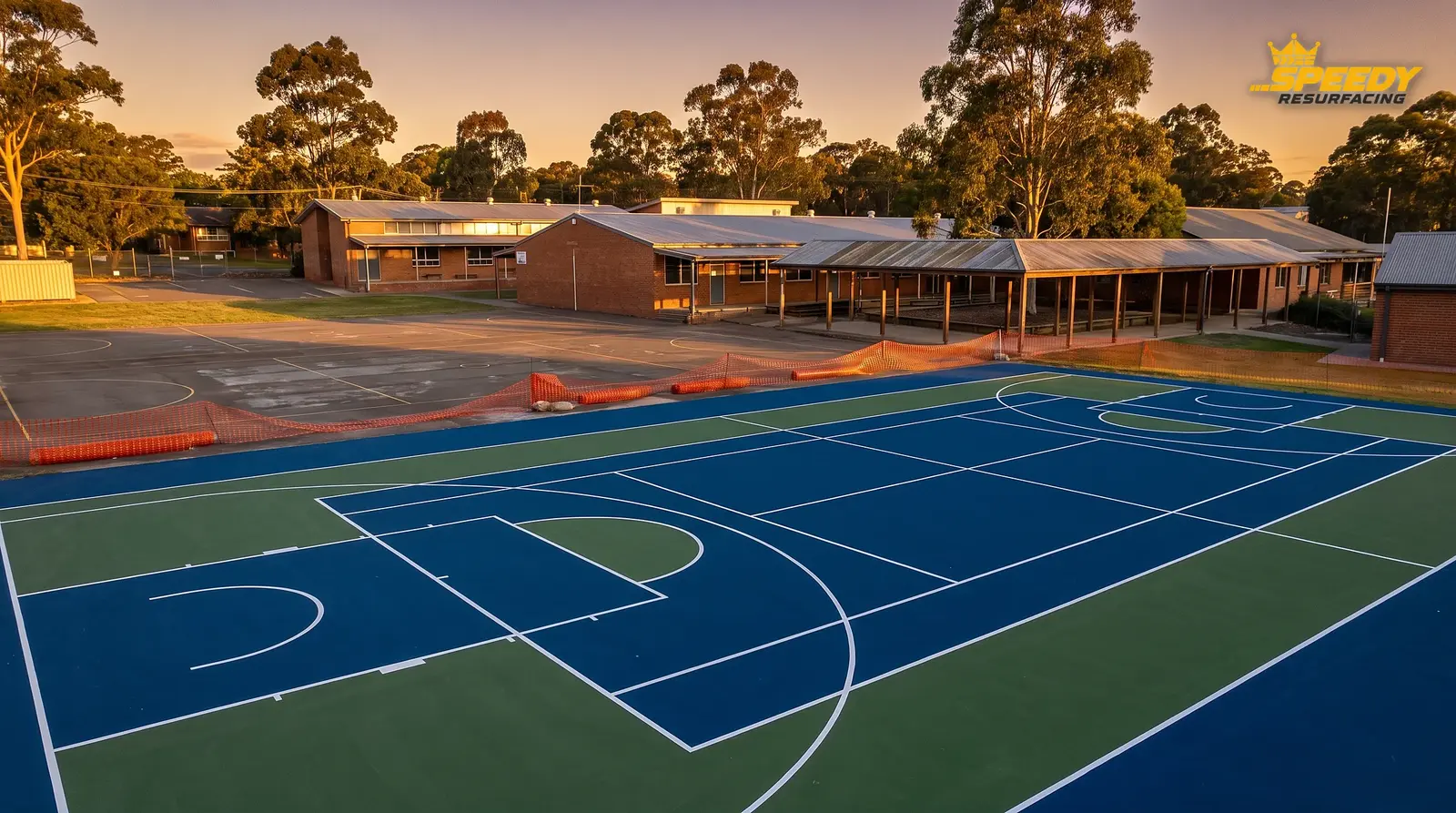

Restoring School and Community Sports Courts in Blacktown: Access, Planning, and Multi-Sport Upgrades
A practical guide for Blacktown school executives, sports facility managers and community committees — how a full acrylic resurfacing fits inside a two-week school holiday, how adjoining courts and playgrounds stay open during the works, how to add pickleball to an existing basketball or tennis footprint, and exactly which photos to send for an accurate quote.
- A standard multi-coat acrylic resurfacing takes 5–7 operational days — it fits a two-week NSW school holiday with buffer for curing before term resumes.
- Touch-dry is 1–4 hours; full cure needs 24–48 hours of clear weather. Acrylics are not applied below 10 °C or above 35 °C, or in rain.
- Adjacent courts and playgrounds can stay open with physical exclusion fencing, vacuum-shrouded grinding, wash-water bunds and staged delivery routes.
- A standard basketball court takes two pickleball courts (20 × 44 ft each plus 7 ft kitchens); a tennis footprint (~36.6 × 18.3 m) yields two to four.
- Three-tier line hierarchy — 50 mm white or yellow primary, muted secondary, two-tone colour zones — keeps stacked markings legible.
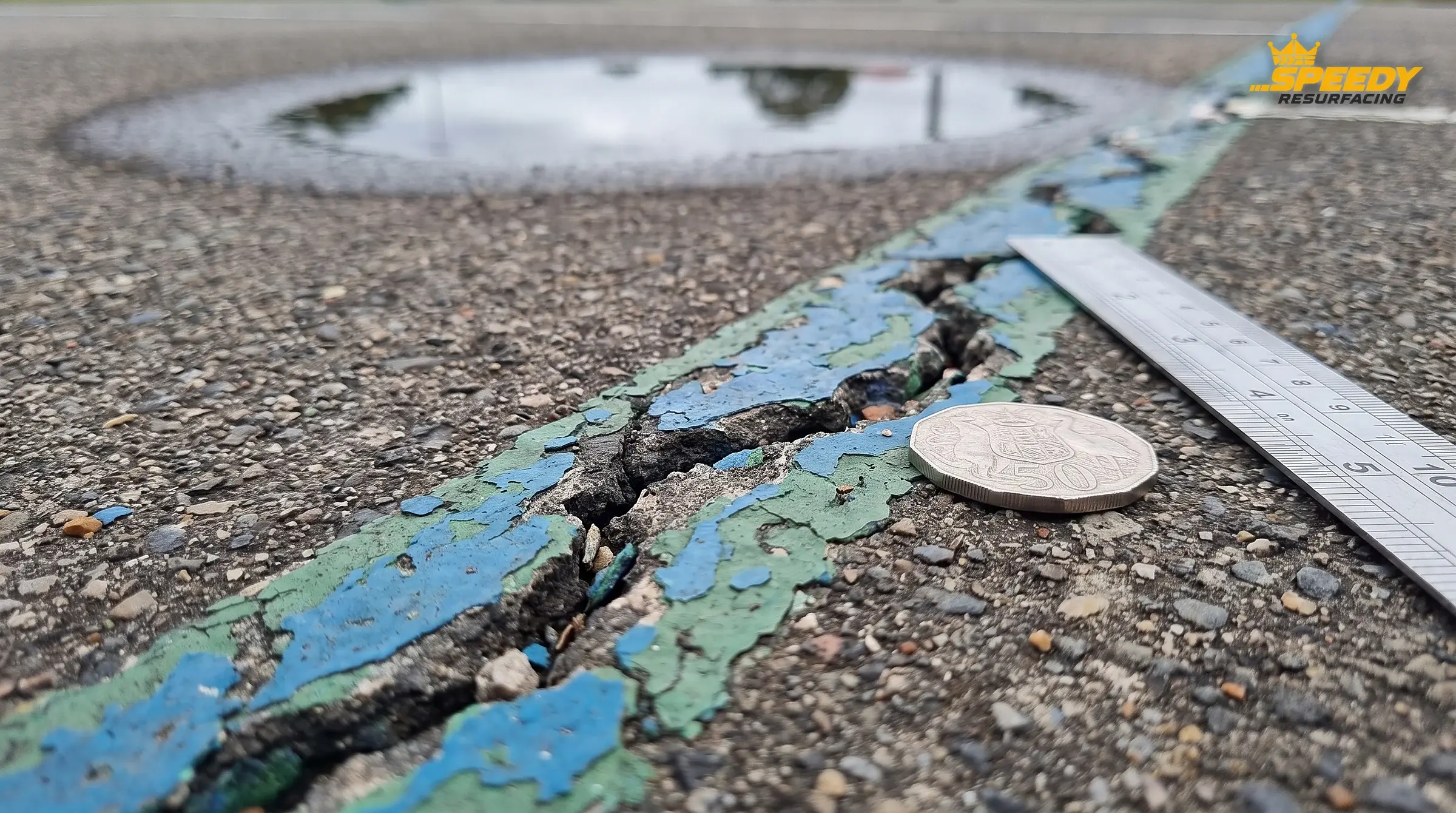
- For a fast quote send wide shots from two opposite corners, close-ups of defects with a coin for scale, ponding photos 30–60 minutes after rain, and the access route from the street to the court gate.
Speedy Resurfacing acknowledges the Traditional Custodians of the land on which we live and work, including the Gadigal people of the Eora Nation across the Sydney basin. We pay our respects to Elders past, present, and emerging, and recognise their continuing connection to the land, waters, and culture of New South Wales.
Quick Summary: Key Project Takeaways
- Can resurfacing fit into a two-week school holiday?: Yes. A standard multi-coat acrylic court resurfacing project can usually be completed in 5 to 7 operational days, leaving adequate buffer for curing before term resumes.
- Can adjacent court areas remain open?: Yes. With staged safety exclusion zones, clear physical barriers and dust control during grinding, surrounding play areas can remain functional.
- What sports can be combined?: Basketball, netball, tennis and pickleball can be integrated onto a single surface using a high-contrast colour hierarchy and line prioritisation.
- Fast quote request: To arrange a site assessment or submit court photos for review across Blacktown and Greater Sydney, email info@speedyresurfacing.com.au or call 0466 495 495.
The Demands on Blacktown Sports Facilities
School and community sports courts across Blacktown face continuous, high-volume use. During weekdays, educational facilities require resilient surfaces for physical education, recess and school sport. On weekends and evenings, many of these same courts host local club competitions, social leagues and casual recreational play. Over time, heavy foot traffic combined with Sydney's intense summer UV exposure and rainfall degrades the court binder. Typical signs of wear on asphalt and concrete courts include:
- Surface binder oxidation: The court loses its vibrant colour, feeling chalky or abrasive.
- Micro-cracking and hairline fractures: Small gaps open up, allowing moisture penetration into the sub-base.
- Loss of surface traction: Worn acrylic coatings lose aggregate texture, creating slick spots underfoot when wet.
- Low spots (ponding): Rainwater pools in depressions rather than draining away evenly.
- Confusing or faded line markings: Multiple layers of old, flaking game lines make boundaries unclear.
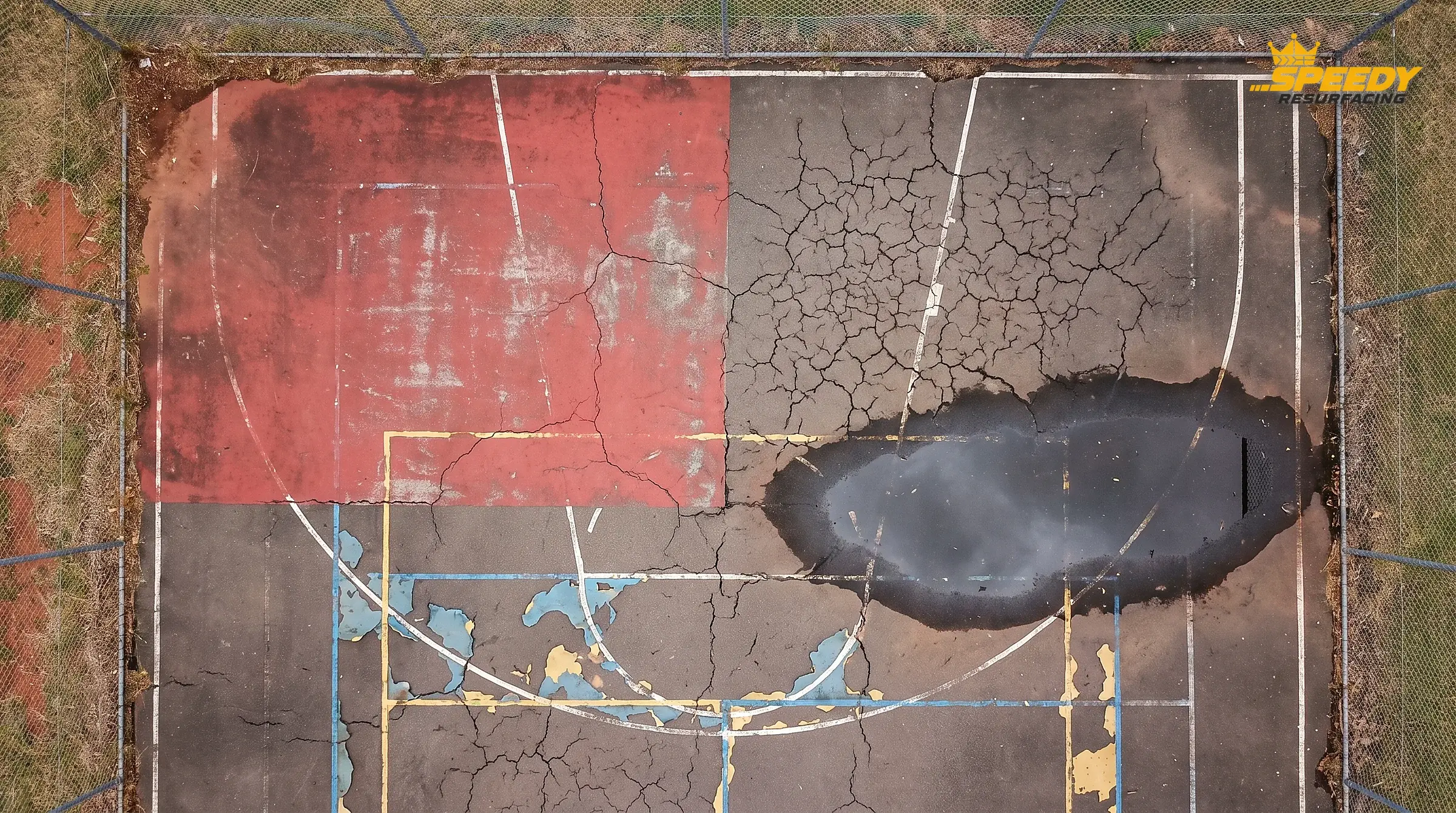
Restoring these assets requires more than applying a quick coat of standard paint. True sports court resurfacing is a multi-layered acrylic coating system engineered to restore structural integrity, uniform ball bounce and predictable traction.
Can Court Resurfacing Fit Into a Two-Week School Holiday Window?
A primary concern for school business managers and facility directors is avoiding disruption to student routines and scheduled sports programs. The two-week NSW school holiday period provides an ideal window for major court restoration — provided the project is carefully planned. Under normal weather conditions, a standard acrylic court resurfacing project proceeds through distinct technical phases:
| Day | Work Phase | Technical Focus & Requirements |
|---|---|---|
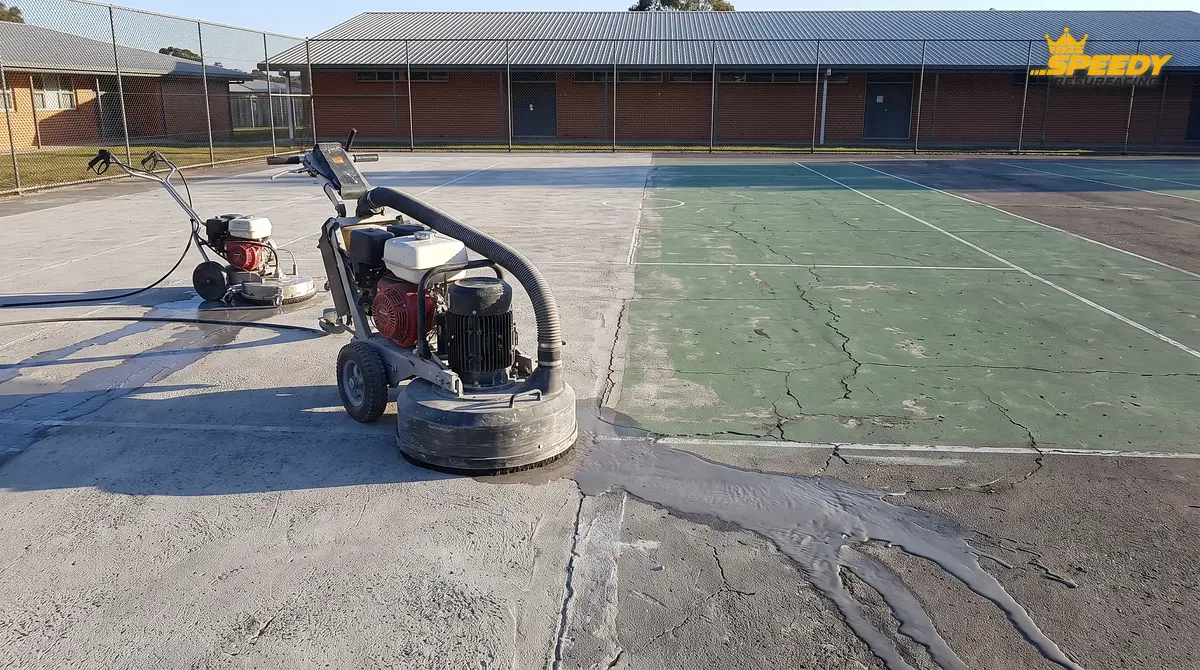
| Day 1 | Site prep & cleaning | High-pressure washing, oil degreasing and mechanical surface grinding to strip failing coatings |
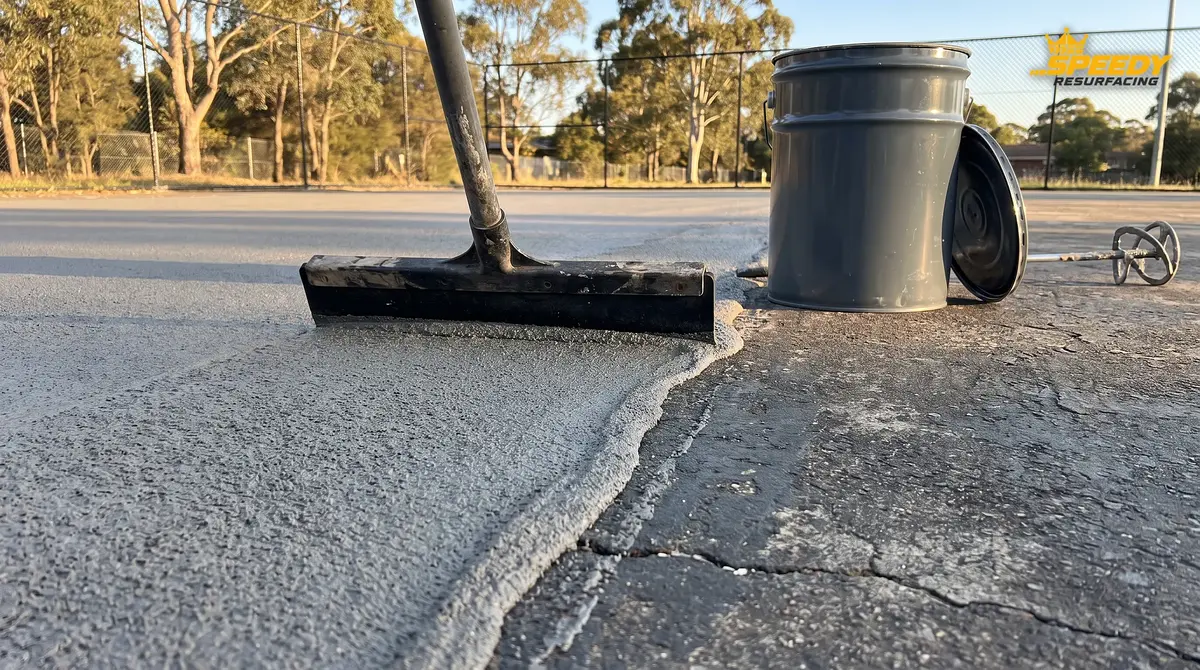
| Day 2 | Base repairs & patching | Acrylic crack fillers and levelling compounds for low spots (ponding areas) |
| Day 3 | Acrylic resurfacer base | Heavy-bodied acrylic resurfacer containing silica sand to seal porous asphalt or concrete |
| Day 4–5 | Colour premium topcoats | Two coats of UV-stable acrylic colour resin for playing zones and key areas |
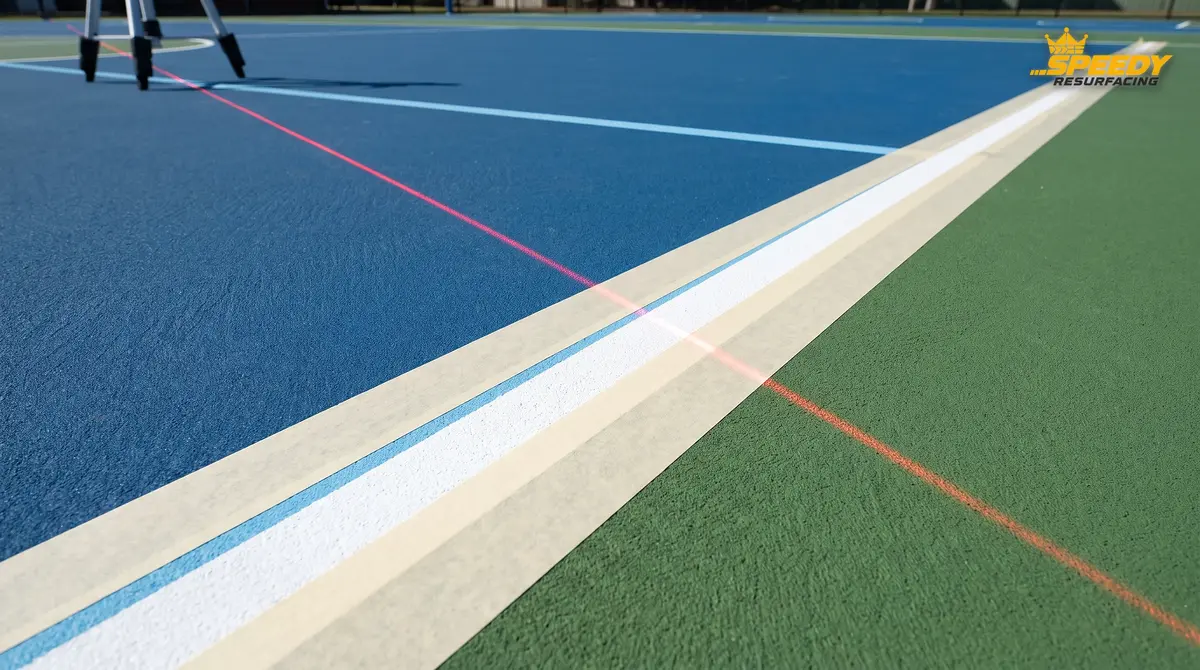
| Day 6 | Precision line marking | Laser-guided layout and hand-painted game lines for primary and secondary sports |
| Day 7+ | Curing & handback | Full chemical cure before reopening for heavy athletic foot traffic |
Curing vs. Drying: The Weather Factor
It is essential to distinguish between touch-dry time and full service curing. According to acrylic surface manufacturer specifications, individual acrylic coats may dry to the touch in 1 to 4 hours under warm, dry conditions. However, the full acrylic matrix requires complete evaporation of water content to cure properly. Environmental conditions common to Western Sydney directly impact this timeline:
- Temperature: Acrylic materials should not be applied when surface or ambient temperatures drop below 10 °C or exceed 35 °C.
- Rain and humidity: Moisture during or immediately following application will compromise binder adhesion.
- Curing window: A minimum of 24 to 48 hours of clear weather post-completion is ideal before permitting full gameplay.
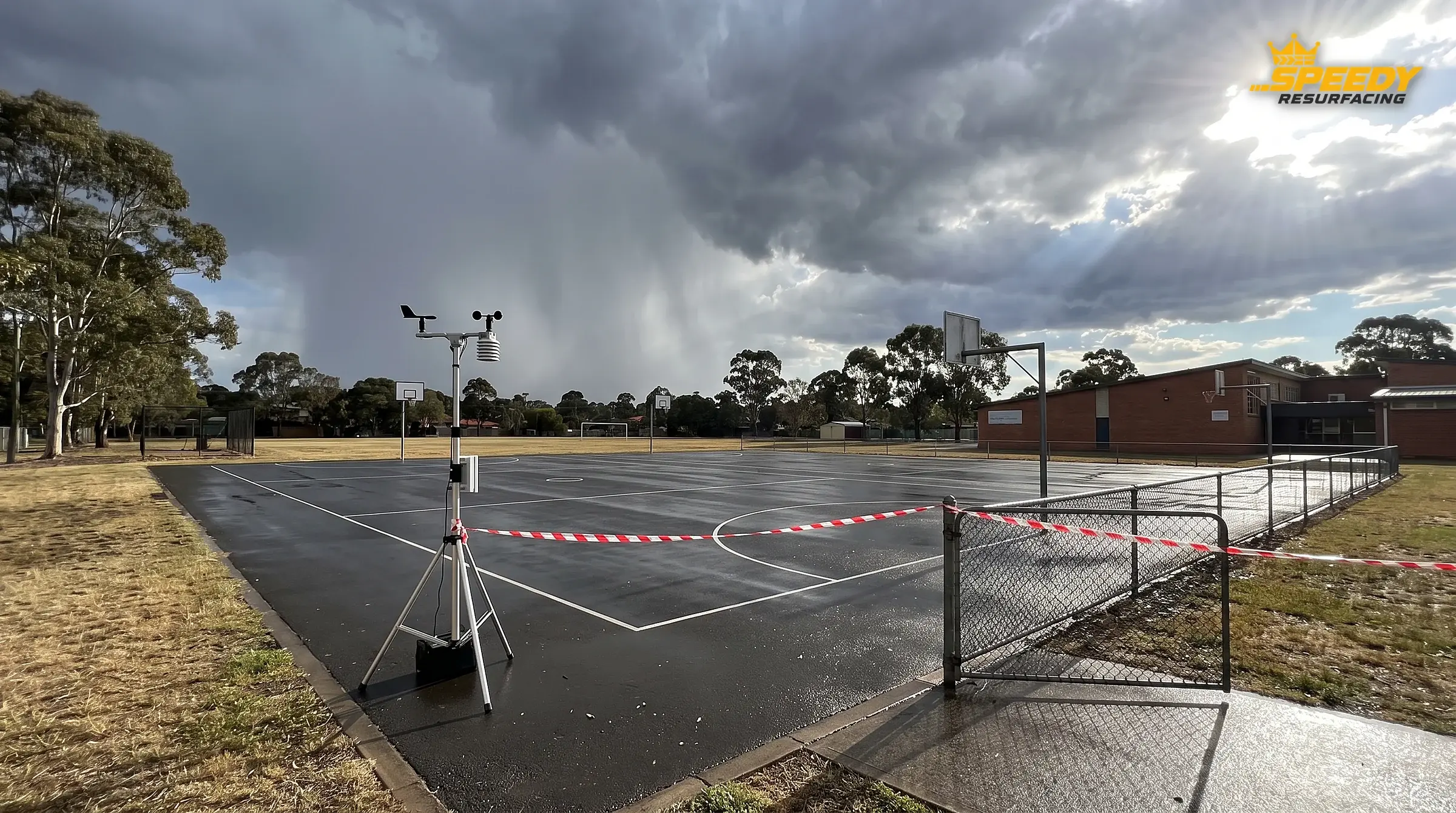
By scheduling surface grinding and repairs on Day 1 of the holiday break, the project gains a comfortable buffer against unexpected rain delays, ensuring the court is fully cured and ready for school return.
Minimising Site Disruption: Working Alongside Adjoining Areas
Facility managers often ask whether an entire sports precinct must shut down while one court is being resurfaced. In multi-court complexes or schools with adjacent playgrounds, partial operation is frequently achievable. To maintain safety and protect adjacent active areas, court resurfacing requires structured site isolation:
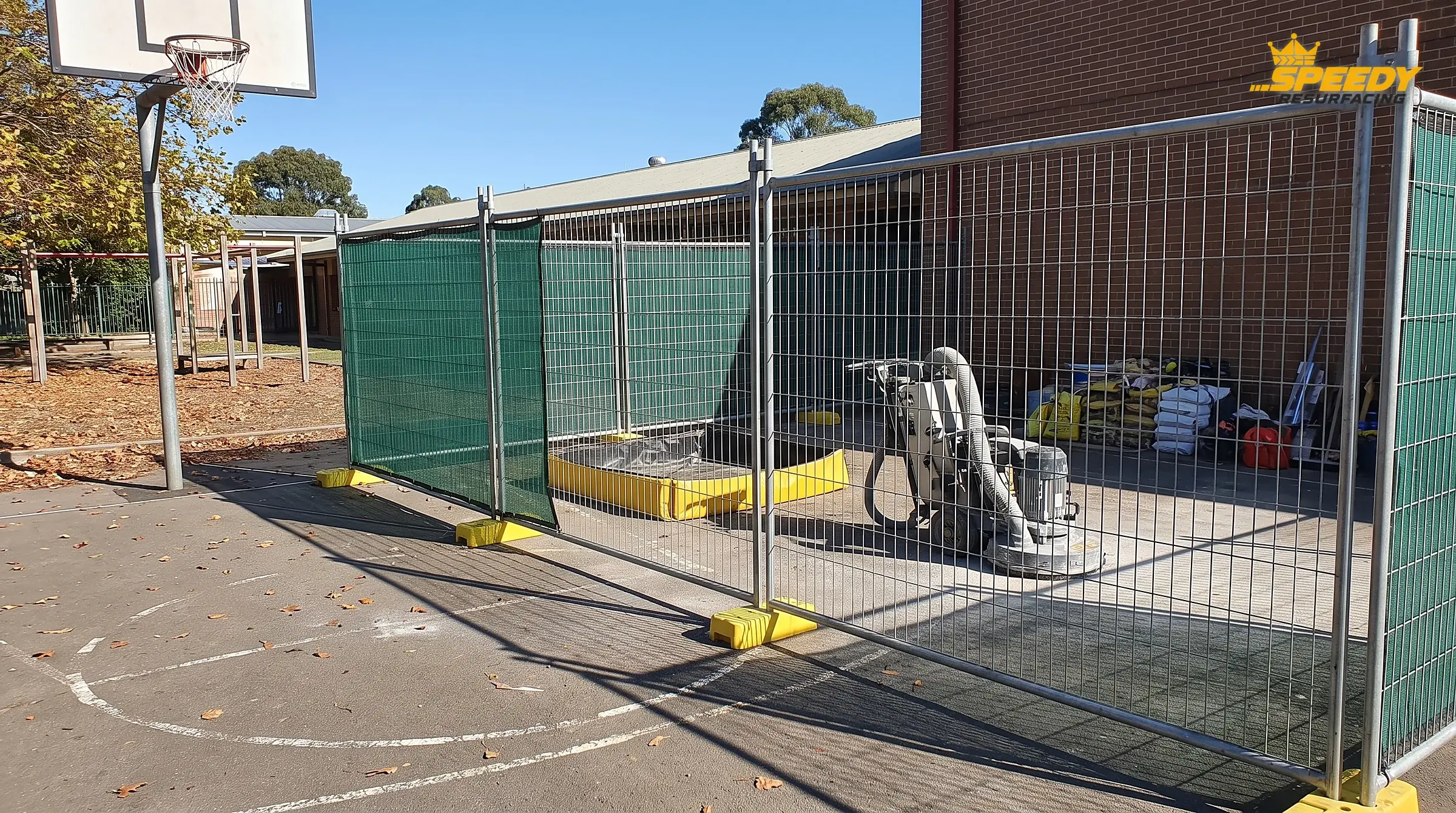
- Physical exclusion zones: Temporary chain-link or mesh safety fencing prevents unauthorised entry, ball travel or wind-blown debris onto wet acrylic coatings.
- Dust & wash-water control: Mechanical grinding equipment uses vacuum shrouds to catch airborne concrete dust, while containment bunds keep wash water away from active play areas.
- Staged delivery routes: Equipment and material storage are routed away from primary student or pedestrian pathways.
Converting Existing Courts for Pickleball & Multi-Sport Use
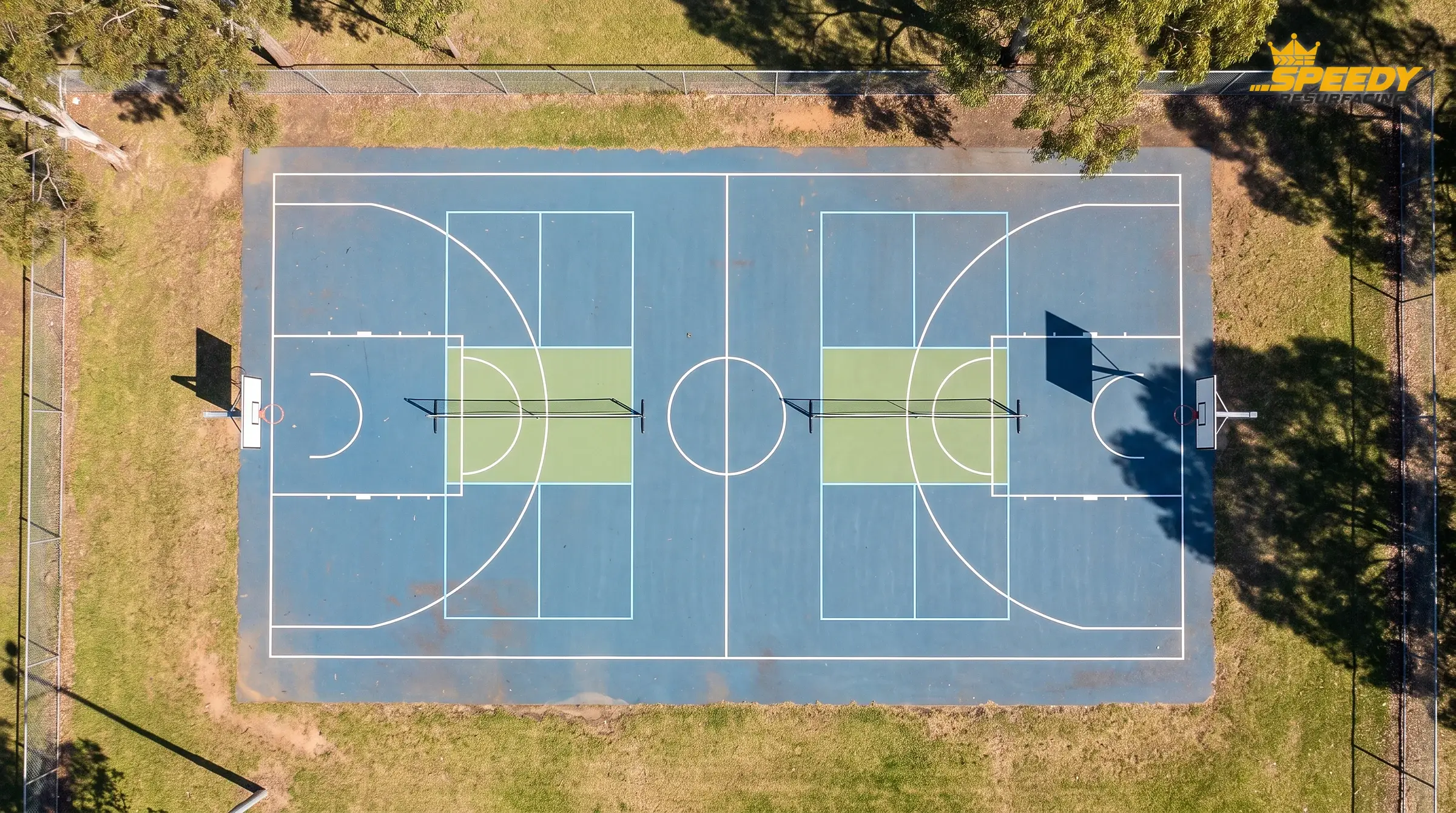
With the rapid growth of pickleball across Sydney, many Blacktown schools and community clubs are upgrading single-use tennis or basketball courts into versatile multi-sport hubs. When integrating pickleball into an existing primary basketball court footprint, spatial planning must account for overlapping boundaries. A standard basketball court can accommodate two dedicated pickleball courts aligned lengthwise or crosswise, provided each pickleball zone incorporates its standard 20-foot by 44-foot playing area alongside the required 7-foot non-volley zone (the kitchen) and appropriate service boxes. Distinct, high-contrast line colours and two-tone surface painting ensure players can easily distinguish primary basketball boundaries from secondary pickleball markings without visual clutter.
Governing Body Dimensions & Space Considerations
Adapting a court footprint requires strict adherence to sport-specific spatial guidelines:
- Basketball: The FIBA standard playing court measures 28 m × 15 m. Including required boundary run-off spaces, the total recommended footprint is 32 m × 19 m.
- Pickleball: According to the USA Pickleball Official Rulebook, the standard court playing area is 20 ft × 44 ft (approximately 6.10 m × 13.41 m), featuring a 7 ft (2.13 m) non-volley zone on either side of the net. Including required safety run-off, a standalone pickleball court requires a minimum overall space of 30 ft × 60 ft (9.14 m × 18.28 m).
- Multi-court yield: A single standard tennis court footprint (roughly 36.6 m × 18.3 m total) can comfortably accommodate two to four dedicated pickleball courts, depending on fencing and access arrangements.
Maintaining Line Hierarchy and Visual Clarity
When layering basketball, netball and pickleball markings onto a single surface, visual clarity is critical to prevent player confusion:
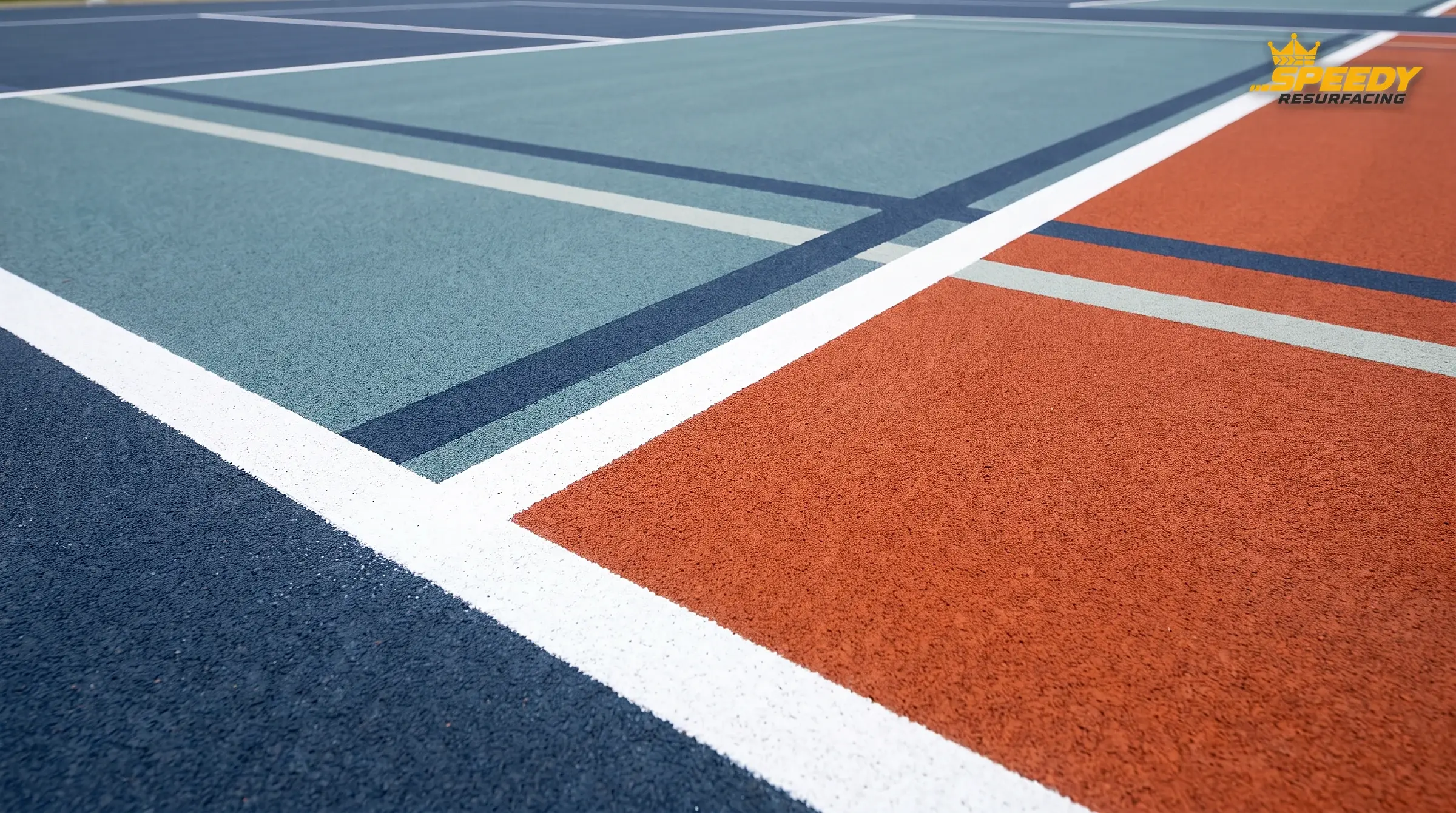
- Primary sport (high contrast): The main sport, for example basketball, receives 50 mm wide lines in a high-contrast colour such as bright white or yellow.
- Secondary sport (subdued tone): Secondary markings, for example pickleball, use a distinct, slightly muted shade such as light blue, pale grey or navy that remains legible up close without clashing with primary lines.
- Two-tone colour zones: Contrasting acrylic shades for the main playing keys, surrounds and pickleball non-volley zones intuitively define play spaces without over-relying on line markings.
Day 1 of the holidays is the most valuable day of the project — every hour of grinding you bank then is an hour of rain you can absorb later.
Speedy Resurfacing
What Photos to Take for an Accurate Resurfacing Quote
Requesting a preliminary assessment and scope of work is fast and straightforward. Clear visual information allows estimators to evaluate surface condition, repair requirements and access limitations accurately before coming on site. When submitting details for a court restoration quote across Blacktown and Greater Sydney, capture these photographs:
- 01
Overall footprint shots
Stand at two opposite corners of the court to capture wide photos showing the full surface, perimeter fencing, light towers, surrounding trees and slope.
- 02
Close-ups of surface defects
Take clear photos of existing cracks, surface flaking, structural expansion joints or exposed aggregate. Place a coin, ruler or pen next to cracks to provide scale for width and depth.
- 03
Ponding / water depressions
Photograph 30 to 60 minutes after rainfall. Low spots where water collects indicate where specialised acrylic levelling compounds must be applied.
- 04
Site access routes
Capture the access path leading from the street or parking area to the court gates. This verifies equipment clearances for surface grinding machinery.
Request Your Blacktown Court Site Assessment
Proper planning, thorough surface preparation and correct product curing are the foundation of a durable sports court. Whether restoring a school playground in Blacktown, upgrading community netball courts or converting under-utilised surfaces into multi-sport pickleball courts, Speedy Resurfacing brings deep technical expertise to every project. Leave your name, mobile and email below, email info@speedyresurfacing.com.au or call 0466 495 495. Speedy Resurfacing is the specialist court division of Speedy Line Marking.
Frequently Asked Questions
Know a school, club or court owner who needs this?
Send them the article in one tap, and follow Speedy Resurfacing on Instagram @speedyresurfacing and Facebook for before-and-after court transformations across Sydney.