
Why Surface Preparation Determines the Quality of a Resurfaced Court
The colour coat is the part everyone sees — but a resurfaced court lives or dies on what happens before it. Grinding, pressure cleaning, crack routing, flood testing and priming account for roughly 80% of a court's long-term performance. Here is what elite preparation looks like, what the shortcuts look like, and how the Speedy method handles Western Sydney slabs.
- Surface preparation accounts for roughly 80% of a resurfaced court's operational utility and lifespan — the colour coat is the last thing you see, not the thing that lasts.
- Acrylic systems need a ground, porous, contaminant-free profile to bond; paint over smooth, dirty or flaking surfaces peels within months.
- Cracks are V-cut and filled with flexible elastomeric acrylic binders so they move with Western Sydney's seasonal ground movement instead of reflecting through.
- Birdbaths deeper than a two-dollar coin are found by flood testing and levelled with acrylic patch and silica mixtures before any colour is applied.
- A dedicated primer/binder coat equalises suction across the slab so every subsequent layer cures evenly.
- The Speedy method: assessment & drainage analysis → grinding & crack repair → multi-layer silica-textured acrylic → laser-guided line marking.
Speedy Resurfacing acknowledges the Traditional Custodians of the land on which we live and work, including the Gadigal people of the Eora Nation across the Sydney basin. We pay our respects to Elders past, present, and emerging, and recognise their continuing connection to the land, waters, and culture of New South Wales.
While the visual finish of a new court is immediately obvious, its underlying structural integrity and long-term lifespan depend almost entirely on comprehensive substrate preparation. Whether managing a high-use school court in Merrylands, upgrading council sports facilities across Western Sydney, or restoring a private residential slab, achieving durable performance requires thorough and correct foundational prep. Skipping these initial steps compromises the structural integrity of the entire court system.
Applying acrylic topcoats over poorly prepared concrete or asphalt leads directly to critical failures such as bubbling, peeling, cracking and premature surface breakdown. At Speedy Resurfacing, alongside our parent business Speedy Line Marking, systematic preparation accounts for roughly 80% of a court's total operational utility and performance longevity. Proper prep ensures strong mechanical adhesion, prevents water trapping beneath layers, levels uneven play zones, and preserves player safety and ball-bounce consistency over time.
The Short, Direct Answer: Why Substrate Preparation Comes First
Surface preparation dictates whether new acrylic coatings chemically and mechanically bond to the concrete or asphalt underneath. Without grinding, pressure cleaning, crack repair and moisture assessment, high-performance acrylic layers cannot adhere correctly. Proper prep prevents water trapping, eliminates flaking, levels uneven play zones, and ensures the finished surface maintains consistent ball bounce and player safety for years.
Local Demands: Court Resurfacing in Merrylands & Western Sydney
Properties across Merrylands, Parramatta and the greater Cumberland area face distinct environmental factors. Western Sydney experiences high summer UV exposure, temperature fluctuations and variable soil movement that places immense stress on outdoor concrete and asphalt slabs.
High foot-traffic sites — local schools, council parks, residential strata complexes and commercial sports hubs — require a surface that resists cracking, fading and loss of traction. Simply "painting over" worn surfaces in Merrylands without addressing underlying wear leads to bubbling and surface breakdown under local weather conditions.
What Poor Surface Preparation Looks Like (The Shortcuts to Avoid)
When contractors attempt to save time or lower costs by cutting preparation steps, the failure of the court is not a question of if, but when.
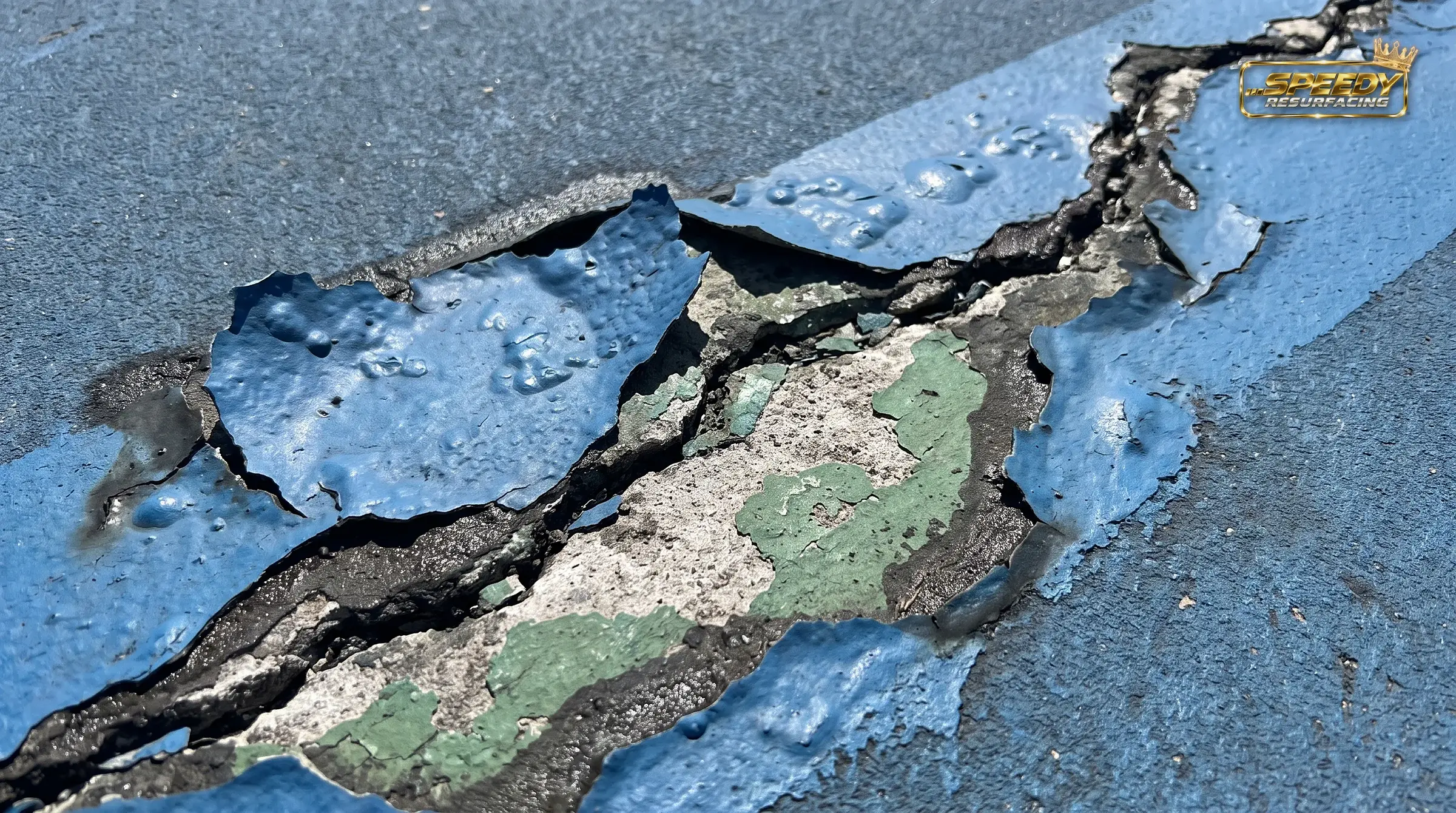
- Painting over unsealed cracks: Applying acrylic topcoats directly over raw structural or surface cracks allows groundwater to seep underneath. Moisture expands, causing the new paint to bubble, lift and break apart.
- Skipping mechanical grinding: Acrylic systems require a textured, porous profile to lock into. Applying coatings over smooth, un-ground or flaking old paint results in poor mechanical adhesion and peeling within months.
- Ignoring dirt, oil and contaminants: Dust, leaf mould and oil spills act as barriers between the substrate and new coatings, causing hollow spots and coating separation.
- Disregarding water pooling ("birdbaths"): Leaving low spots unlevelled creates standing-water zones after rain, accelerating coating deterioration and rendering play areas unsafe.
- Using inferior domestic paints: Applying standard exterior latex or floor paint rather than industrial, UV-stabilised sports acrylics leads to chalking, fading and a dangerous loss of traction.
What Productive, Elite Surface Preparation Looks Like
Productive preparation transforms an aged, weathered slab into a stable, clean and receptive canvas.
Mechanical Grinding and Profile Creation
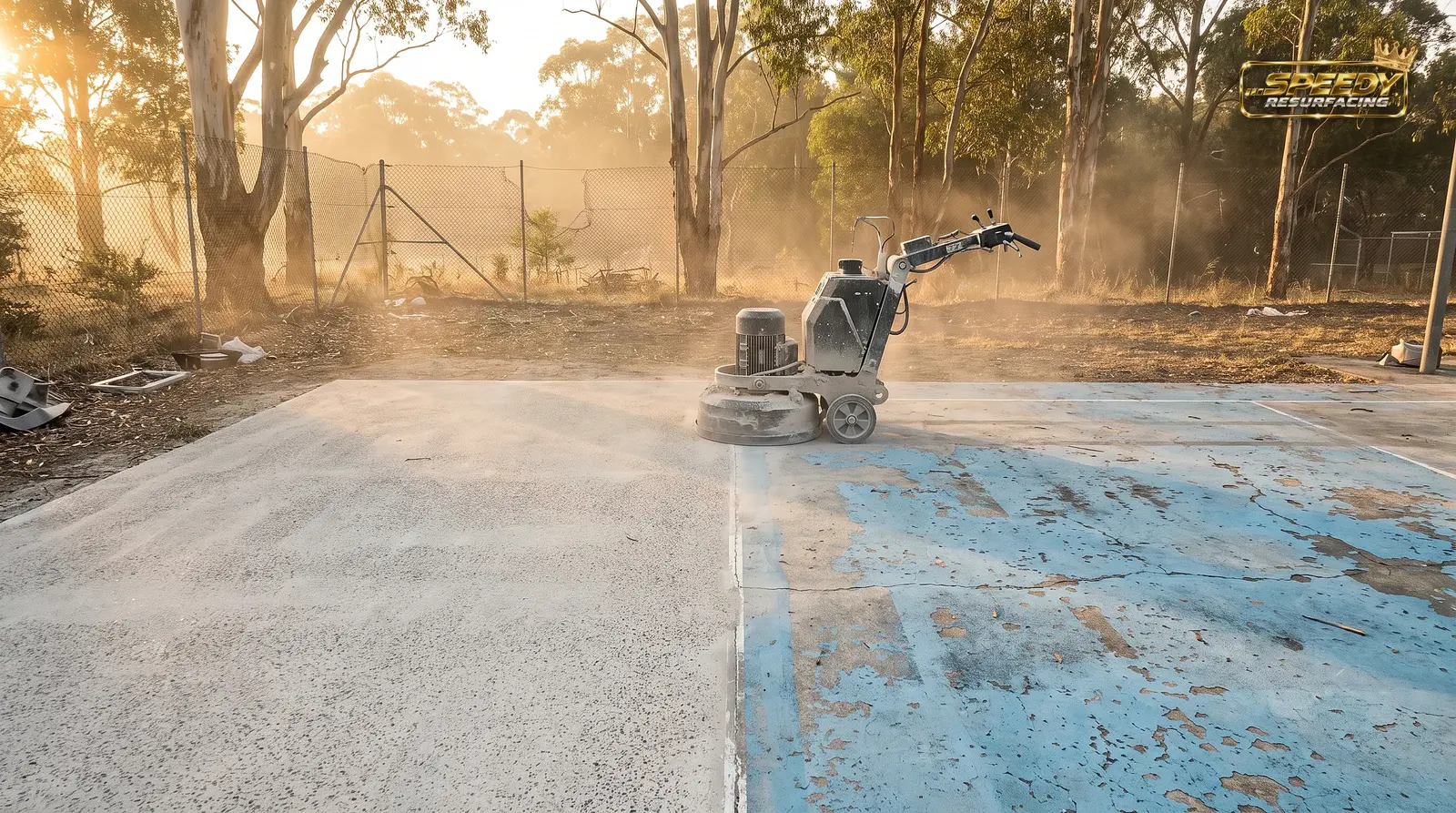
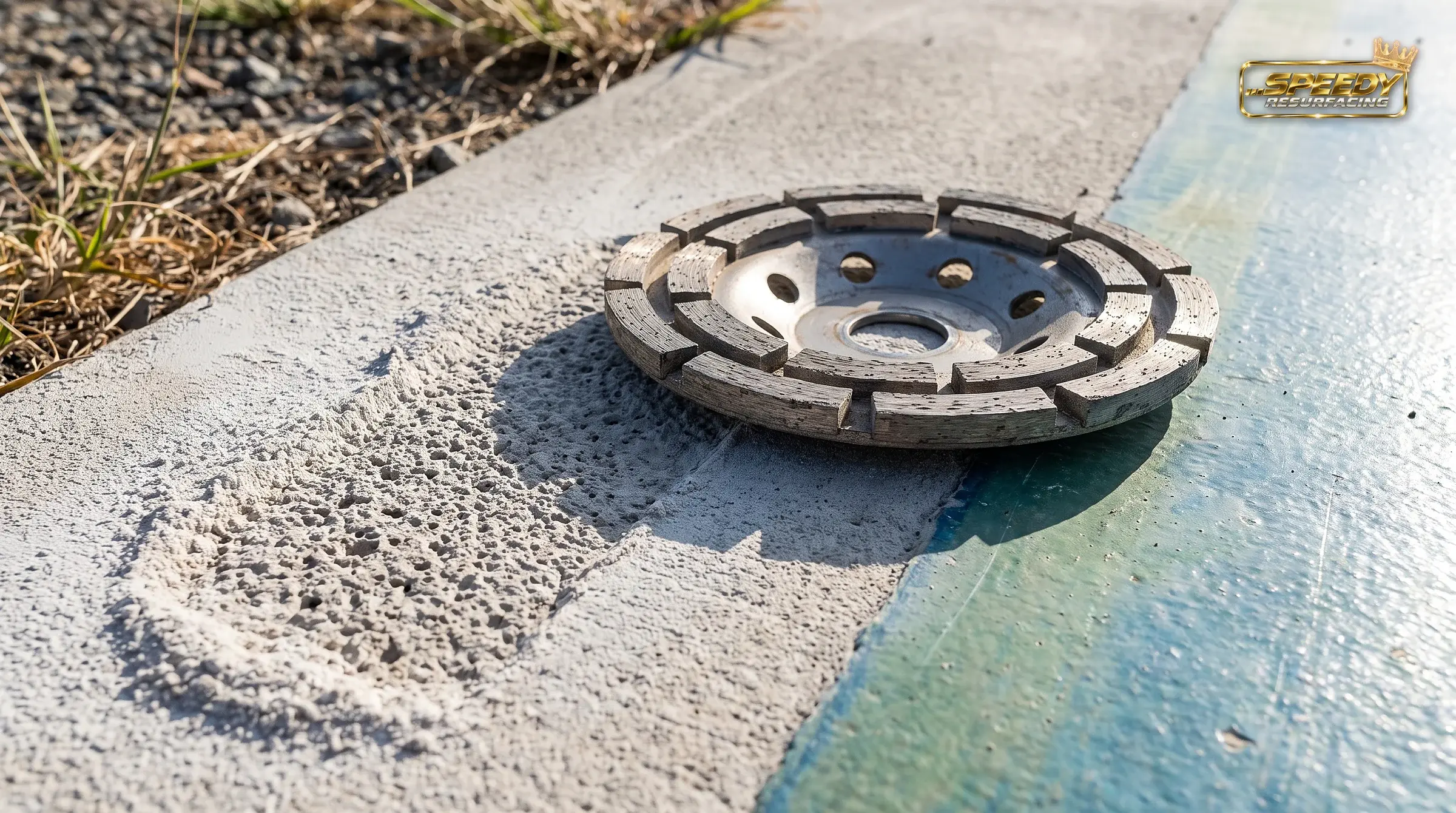
Using diamond-headed grinders or shot-blasters to scarify the concrete or asphalt removes old, failed coatings, laitance and surface contaminants. This process opens the pores of the material, establishing an ideal profile for deep acrylic bonding.
High-Pressure Washing and Chemical Degreasing
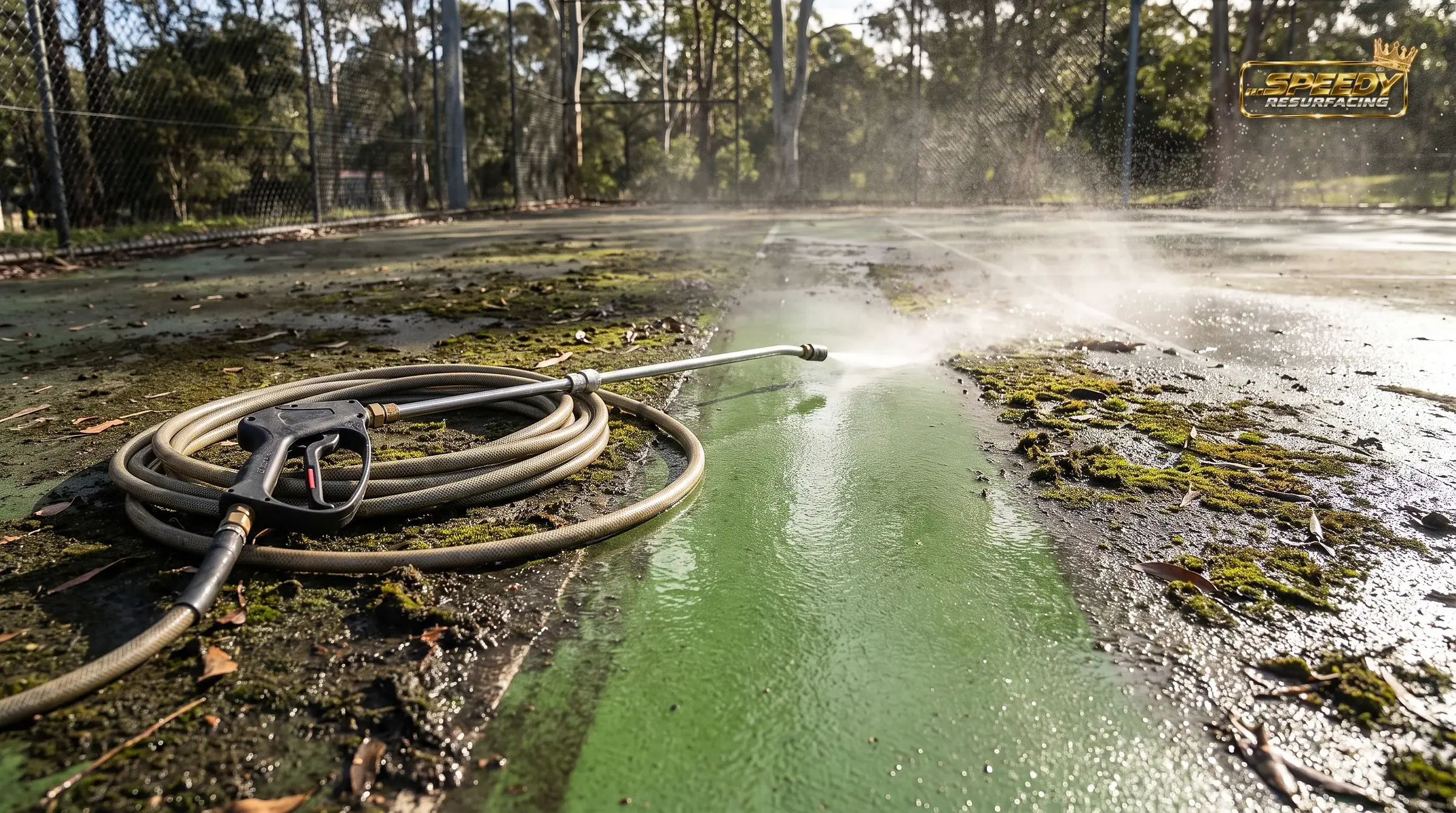
Deep cleaning removes embedded silt, organic matter and industrial oils that mechanical grinding releases. The surface must dry completely before synthetic primers or patch materials are introduced.
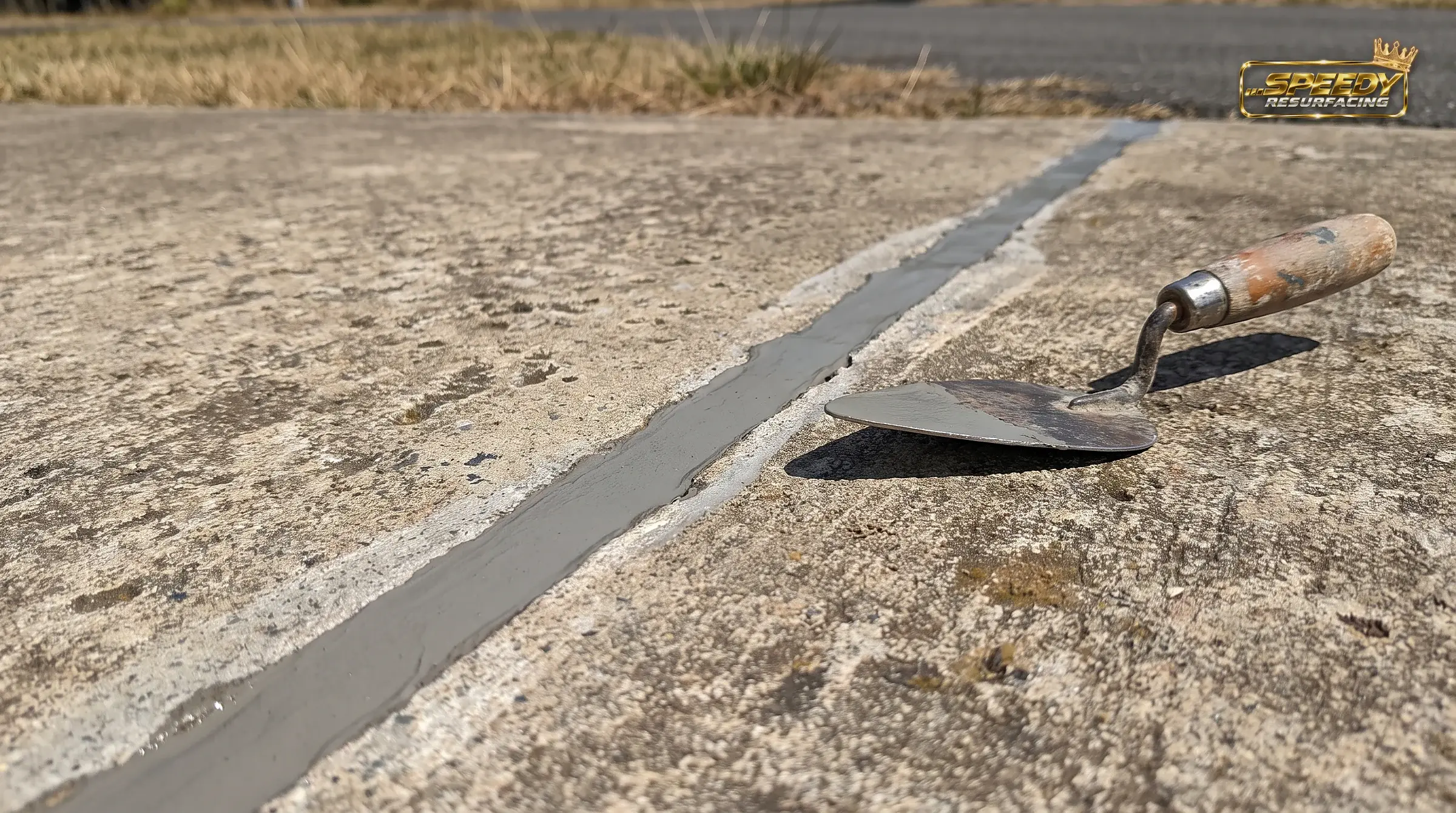
Precision Crack V-Cutting and Flexible Patching
Cracks are mechanically routed out into a "V" profile to clear loose debris. They are filled with specialised elastomeric acrylic binder compounds engineered to move slightly with natural ground thermal expansion, preventing reflection cracking.
Depressions and Drainage Levelling
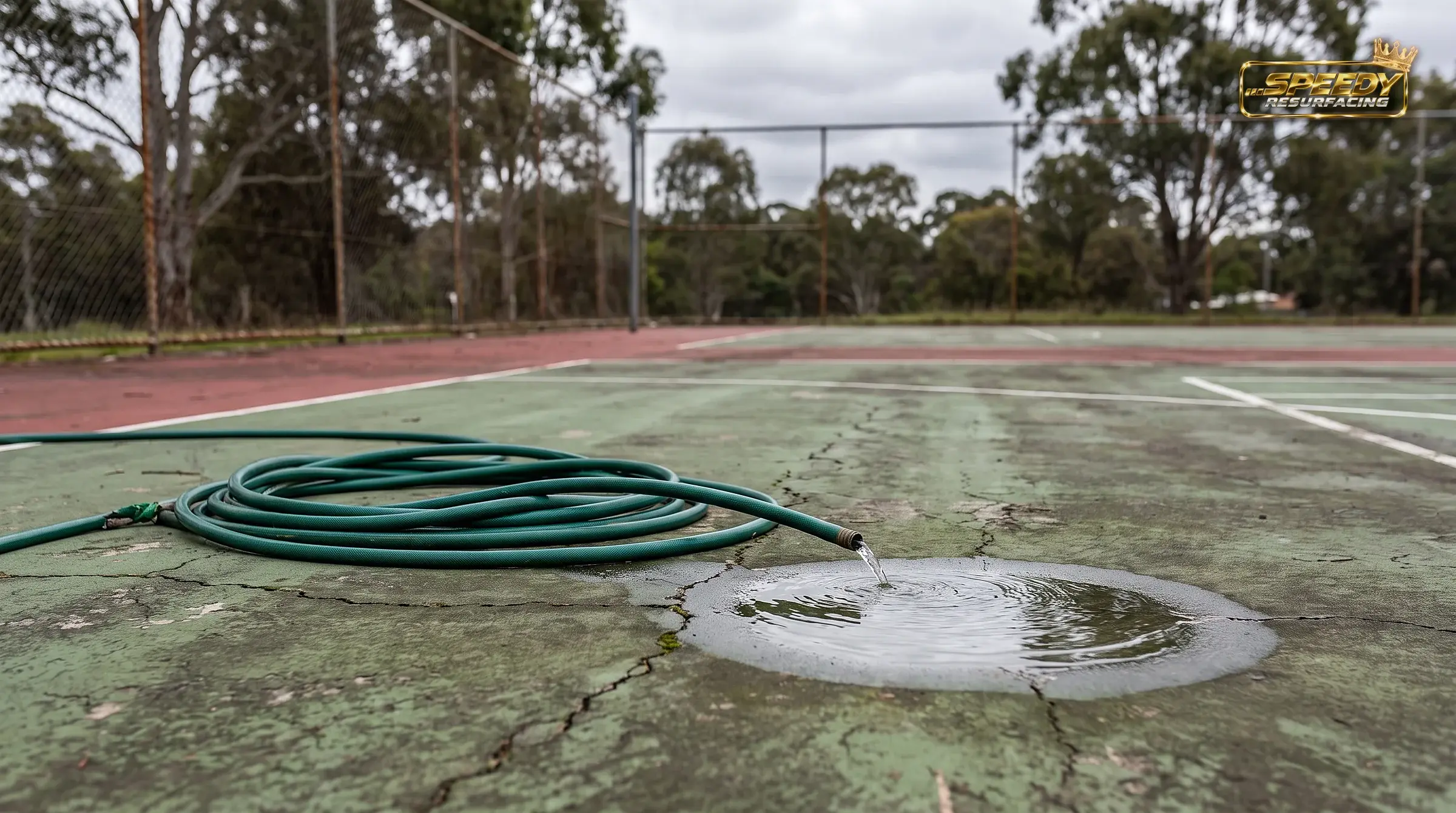
Low points — birdbaths deeper than a two-dollar coin — are identified after controlled water testing. Acrylic patch binders and silica-sand mixtures are trowelled on to level out depressions, ensuring surface water runs off efficiently.
Primer and Penetrating Adhesion Layers
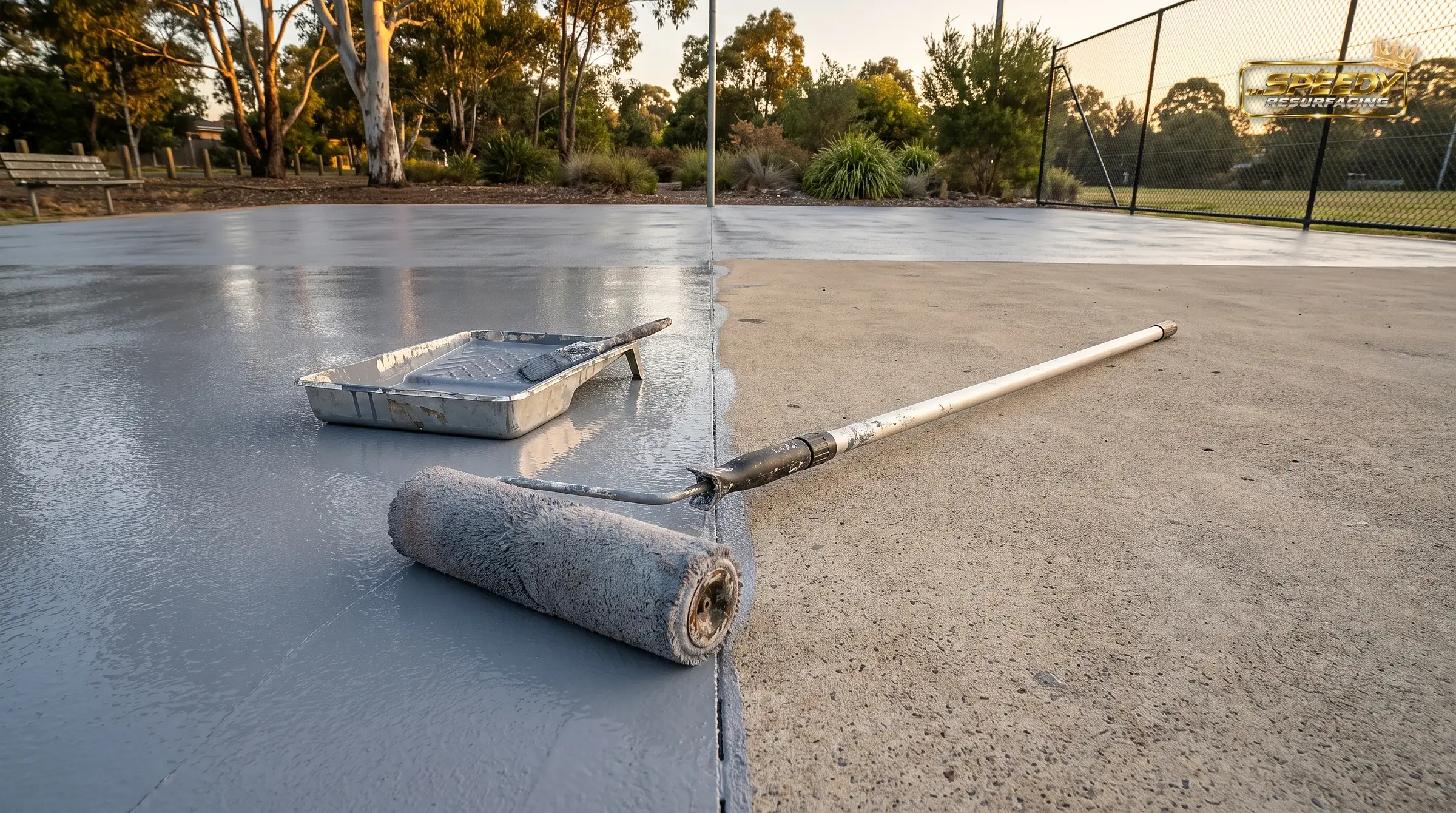
Before colour coats are applied, a dedicated acrylic primer or resin binder is applied. This seals the substrate and creates a uniform suction rate across the entire court floor.
Preparation is roughly 80% of the job. The colour coat is just the part you get to see.
Speedy Resurfacing
The Speedy Line Marking & Resurfacing Method
Our standard is built on the established expertise of our parent business, Speedy Line Marking. We approach every sports court across Sydney as a high-precision trade project that requires systematic execution.
- 01
Comprehensive Site Assessment & Drainage Analysis
Every project across Merrylands and Western Sydney begins with a thorough evaluation of the concrete or asphalt sub-base. We inspect structural slab integrity, moisture movement, existing coating adhesion, surface wear and slope gradient. By flood testing the area we identify low spots and drainage defects so water flows efficiently off the play surface before any new layers are applied.
- 02
Substrate Prep, Grinding & Crack Repair
We deploy diamond-headed scarifiers and high-pressure washing to remove flaking paint, dirt and surface contaminants while opening substrate pores for maximum acrylic adhesion. Cracks are V-cut and filled with flexible elastomeric acrylic binders engineered to accommodate Western Sydney's seasonal ground movement, and birdbaths are levelled with heavy-duty acrylic patch mixtures.
- 03
Multi-Layer Acrylic Sports Coating System
Once the foundation is uniform and dry, we apply a high-performance multi-coat acrylic system designed for intense UV exposure and heavy foot traffic: a deep-penetrating primer/binder coat, heavy-wear acrylic resurfacer layers infused with graded silica sand for slip resistance and consistent ball bounce, then vibrant, non-fading sports colour coats customised for school, council or residential requirements.
- 04
Precision Mathematical & Laser Line Marking
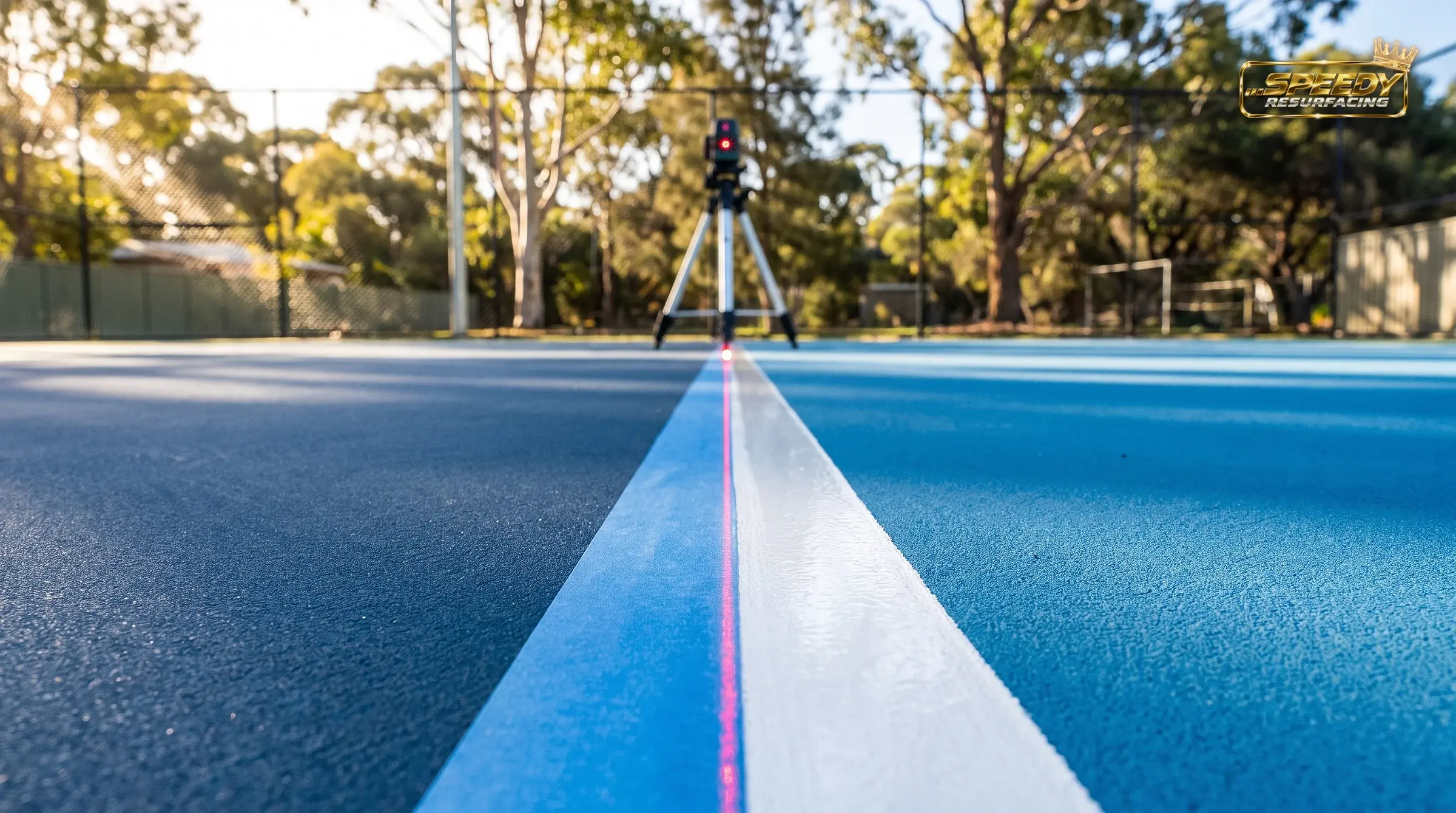
Drawing on the specialist heritage of Speedy Line Marking, the final phase delivers crisp, highly accurate regulatory playing lines. Using laser-guided measuring systems and sharp-edge taping, we apply premium line-marking paints compliant with AS2890 and official sporting codes — basketball, netball, tennis and multi-sport layouts including pickleball conversions.
Bad Preparation vs. The Speedy Resurfacing Standard
| Assessment Point | Unprofessional / Shortcut Method | Speedy Resurfacing Method |
|---|---|---|
| Surface Grinding | Skipped; paint applied straight over dirt and old paint | Full mechanical diamond grinding to open substrate pores |
| Crack Repair | Filled with standard silicone or non-flexible filler | V-cut routing filled with heavy-duty flexible acrylic patch binders |
| Water Pooling | Ignored or painted over | Identified via flood testing and levelled with acrylic patch mixtures |
| Coatings Used | Generic exterior paint or cheap un-textured acrylic | Multi-layered, slip-resistant acrylic sports coating systems |
| Line Marking | Freehand or low-grade tape with bleed-through | Crisp, mathematical, laser-guided sports markings |
| Expected Lifespan | Peels or fades within 6–18 months | Long-term operational utility engineered for Sydney weather |
Who We Service in Merrylands & Across Sydney
Our resurfacing and surface-prep services cater to facilities requiring high utility, safety and longevity:
- Primary & secondary schools: Resurfacing worn multi-sport, basketball and netball courts with vibrant colours and high-traction finishes.
- Local councils & parks: Restoring high-use public recreational spaces in the Cumberland region.
- Commercial sports hubs & gyms: Delivering high-performance surfaces built to withstand continuous daily foot traffic.
- Strata complexes & community facilities: Converting outdated tennis courts into modern multi-use assets, including pickleball conversions.
- Private estates & residential courts: Tailored custom colour layouts and high-end court restorations.
Start Your Court Transformation Today
Don't let poor preparation ruin your sports court investment. Whether you need a complete sports court resurfacing, crack repairs or line marking in Merrylands or anywhere in Greater Sydney, our team delivers results engineered to last. Leave your name, mobile and email below to arrange a comprehensive site assessment, or call 0466 495 495 — email info@speedyresurfacing.com.au.
Frequently Asked Questions
Know a school, club or court owner who needs this?
Send them the article in one tap, and follow Speedy Resurfacing on Instagram @speedyresurfacing and Facebook for before-and-after court transformations across Sydney.