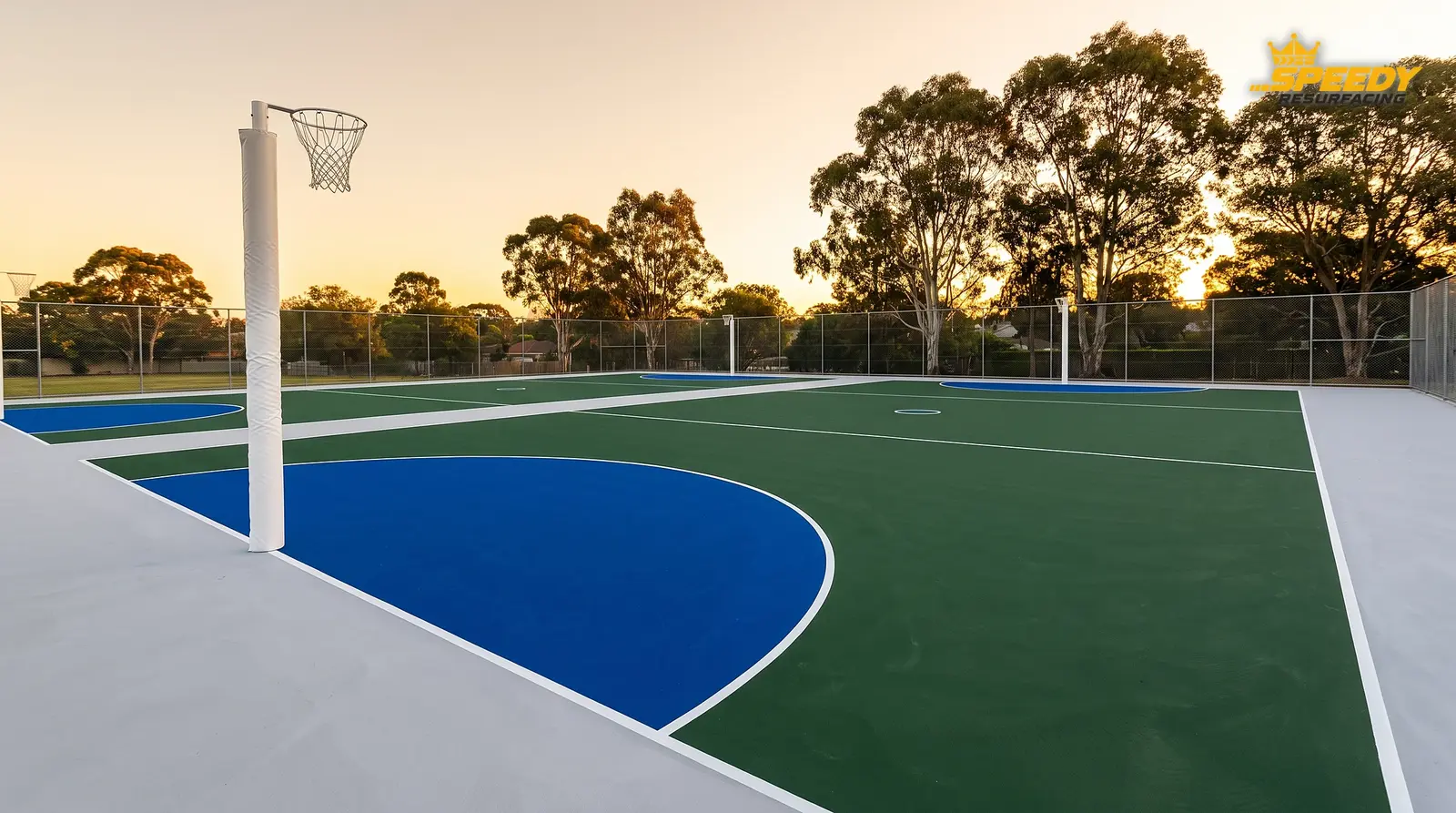

Netball Court Resurfacing Sydney: Geometry, Safety & Multi-Sport Layouts
Netball bans the slide — so the surface has to do all the stopping. This technical guide covers why netball demands engineered traction, the regulation geometry resurfacing re-establishes (30.5 × 15.25 m, 10.16 m thirds, 4.9 m goal circles, 50 mm lines), goal-post sleeve precision, run-off and drainage beyond the lines, how netball shares a court with basketball, and the six-stage professional resurfacing process.
- Netball prohibits foot sliding after the catch, so players depend entirely on surface grip; worn, polished acrylic becomes hazardous when damp.
- Regulation geometry: 30.5 × 15.25 m court, three equal 10.16 m thirds, 0.9 m centre circle, 4.9 m radius goal circles, 50 mm lines, 3.05 m posts (2.4 m junior).
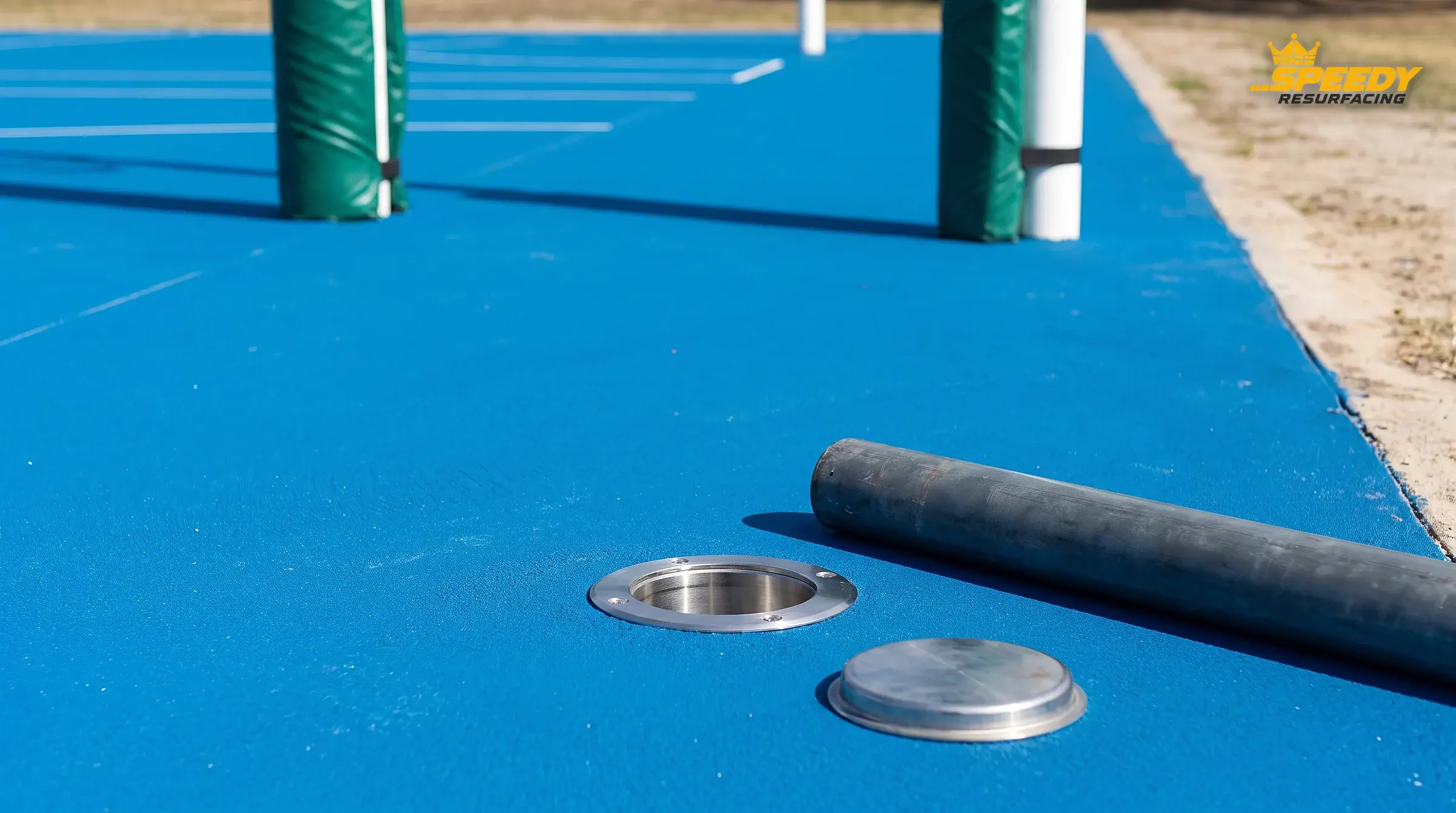
- Goal-post ground sleeves must sit flush and be re-anchored if loose before any coating goes down.
- Netball Australia recommends a 3.05 m clear run-off; constrained sites need an absolute minimum of 1.5–2.0 m with padding on any fixed hazard.
- A 1:100 to 1:120 cross-fall and flexible expansion-joint sealant prevent ponding and joint cracking.
- Netball and basketball share a court using 50 mm primary and 38 mm secondary lines in contrasting colours plus colour-zoned goal circles and keys.
Speedy Resurfacing acknowledges the Traditional Custodians of the land on which we live and work, including the Gadigal people of the Eora Nation across the Sydney basin. We pay our respects to Elders past, present, and emerging, and recognise their continuing connection to the land, waters, and culture of New South Wales.
Netball is one of Australia's most fast-paced, surface-dependent sports. Because netball rules strictly prohibit foot sliding after catching the ball, players rely entirely on immediate surface grip, predictable traction and mechanical stability. When an outdoor asphalt or concrete court degrades — exhibiting polished stone, hairline cracking or water ponding — it immediately compromises player safety, leading to joint strain or severe slip hazards.
Professional netball court resurfacing goes beyond applying a fresh coat of paint. It is an engineered restoration system encompassing sub-base inspection, mechanical grinding, structural crack repairs, flexible acrylic coating layers and laser-guided geometry marking. Whether managing a school facility in Western Sydney, a community sports club or a commercial multi-sport venue, a correctly resurfaced court restores structural longevity and high-performance playability.
Direct Summary: What Netball Court Resurfacing Involves
Netball court resurfacing involves removing failing topcoats, repairing structural cracks, levelling low spots (ponding), applying a multi-layer UV-stable acrylic surfacing system, and applying precision regulation line markings.
- Can netball share a court with basketball?: Yes. Using contrasting paint colours and line hierarchies (such as 50 mm primary lines and 38 mm secondary lines), netball and basketball can co-exist on the same footprint without visual confusion.
- Can court colours be changed?: Yes. Resurfacing allows complete aesthetic customisation, including contrasting court bodies, goal circles and surround margins.
- What lies beyond the lines?: Safe netball court layout requires assessing surrounding run-off zones (a minimum of 3.05 m clearance is standard), post-sleeve integrity, perimeter drainage and impact-absorbing post padding.
Why Netball Demands Specialised Surface Traction
Unlike sports that permit slide transitions, such as clay-court tennis, netball requires rapid acceleration, sharp directional pivots and instant stopping. The sudden deceleration places immense shear force on the surface substrate and the athlete's lower joints. An unmaintained court presents two primary safety hazards:
- Loss of surface texture: Over time, traffic and UV exposure wear down the aggregate texture within the paint, leaving a smooth, glossy surface that becomes hazardous when damp.
- Structural base failure: Cracks, surface flaking or substrate movement interrupt the uniform traction profile, leading to severe trip hazards during high-speed play.
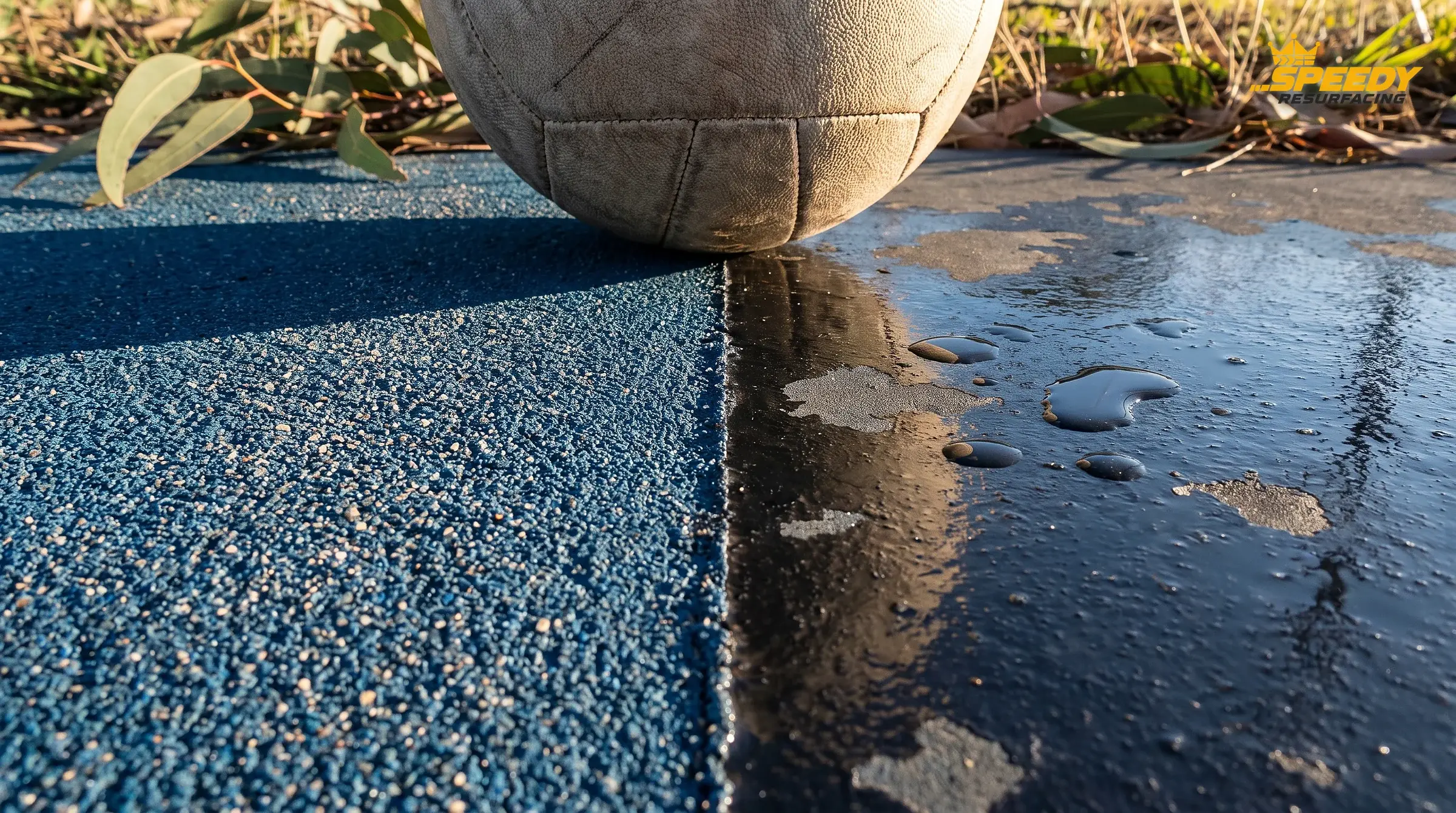
A professional acrylic resurfacing system incorporates graded silica sand within multi-layer acrylic binders. This engineered texture yields a controlled coefficient of friction that delivers consistent traction under dry and damp Sydney weather conditions, drastically reducing slip risks.
Netball Court Geometry & Regulation Standards
Accurate court geometry is non-negotiable for competitive play, school sports and local council facilities. Resurfacing provides the exact baseline required to re-establish regulatory measurements aligned with the Netball Australia Facilities Guidelines.
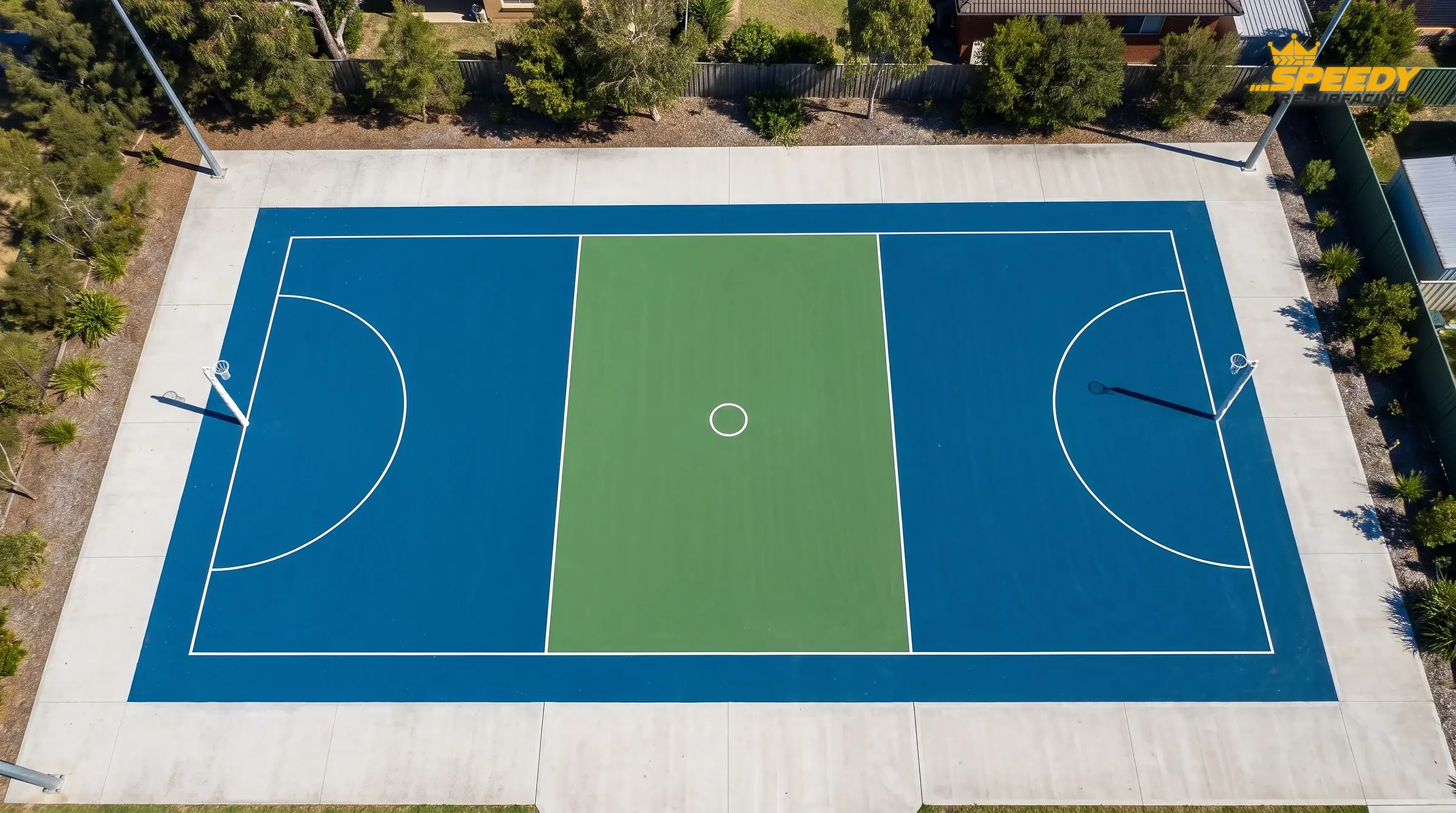
| Court Feature | Official Regulation Dimension | Resurfacing Assessment Focus |
|---|---|---|
| Overall court footprint | 30.5 m long × 15.25 m wide | Full mechanical preparation of the complete playing enclosure |
| Transverse lines | Divide the court into three equal 10.16 m thirds | Verified parallel alignment using laser equipment before marking |
| Centre circle | 0.9 m (900 mm) diameter | Centred precisely at the intersection of the middle-third diagonals |
| Goal circles | 4.9 m (4900 mm) radius | Radius measured from the internal centre of the goal line |
| Line width | 50 mm throughout | Clean, sharp edge definition with high-contrast acrylic line paint |
| Goal post heights | 3.05 m (2.4 m for primary/junior) | Inspection of sleeve anchor depth, vertical alignment and safety padding |
Goal Circle and Post Sleeve Precision
The goal circle is the critical action zone on a netball court. During resurfacing, ground-sleeve anchors for goal posts must be thoroughly inspected. Removable posts require secure ground sockets set flush with the concrete or asphalt substrate to prevent trip hazards. If post sleeves are loose or misaligned, they must be re-anchored into the concrete base before applying acrylic coatings.
Looking Beyond the Lines: Surrounding Space & Site Requirements
A court inspection does not end at the baseline. Surrounding environment conditions directly govern long-term durability and player safety.
Run-Off Zones and Clearance Margins
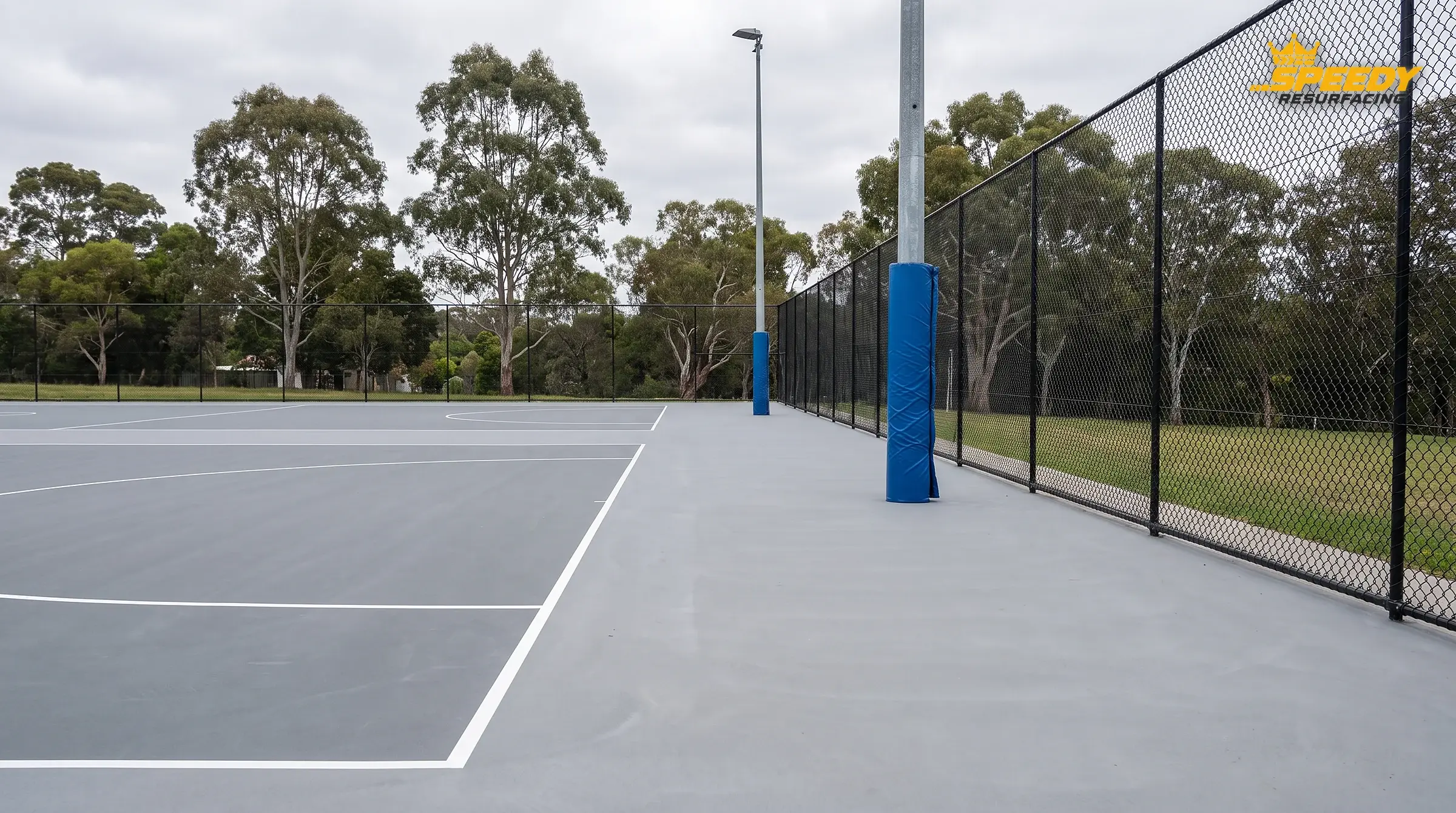
Netball Australia recommends a minimum 3.05 m clear run-off zone surrounding the outer boundary lines. On restricted school or residential sites where 3.05 m is unavailable, an absolute minimum safety clearance of 1.5 to 2.0 m must be maintained, free from fixed obstacles, retaining walls, fences or steep drop-offs. Any non-removable hazards within this perimeter must be fitted with protective impact padding.
Drainage and Slope Gradients
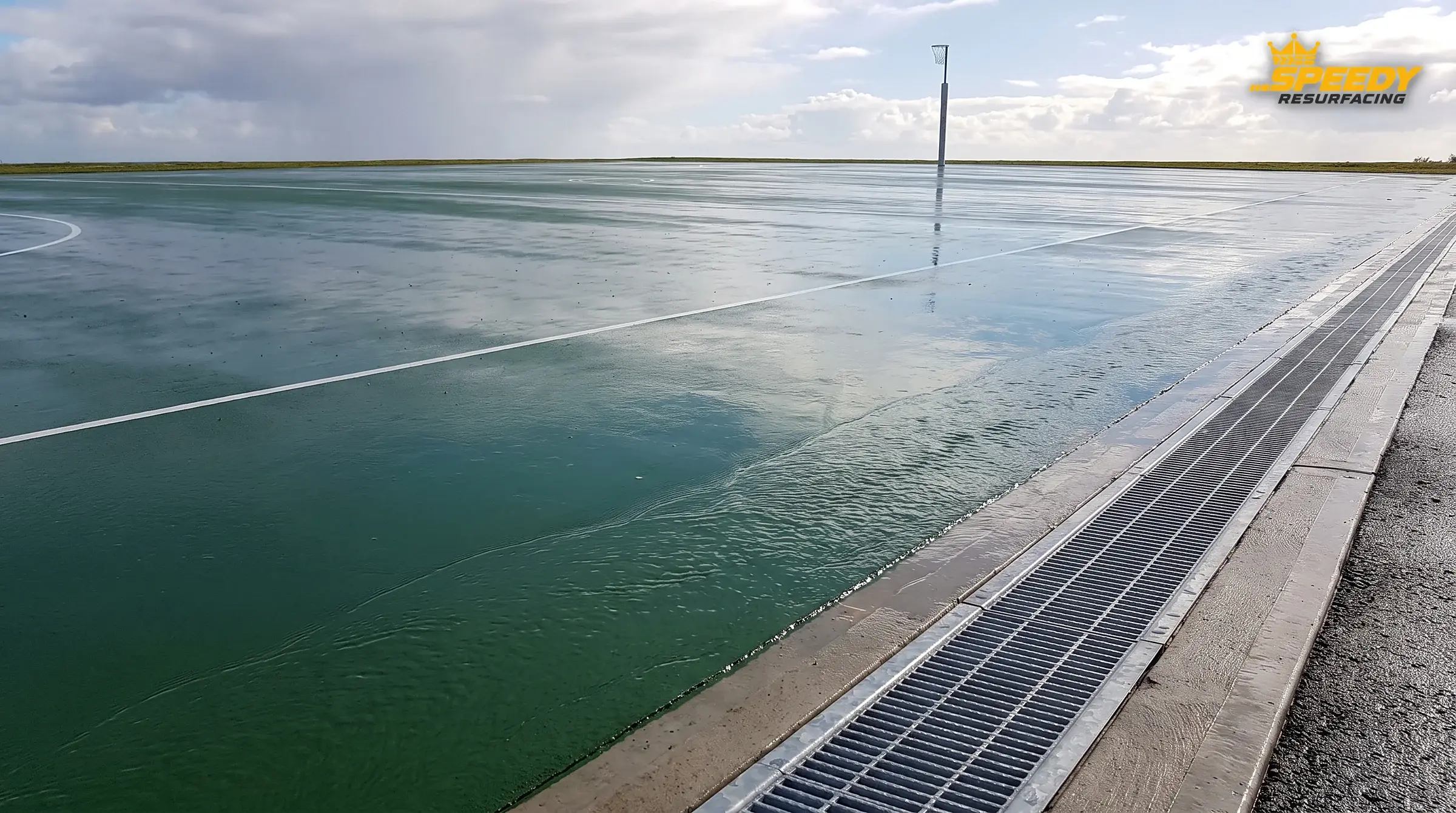
Water accumulation is the leading cause of acrylic delamination and surface breakdown. A netball court requires a deliberate cross-fall slope, typically between 1:100 and 1:120, to ensure water drains freely into perimeter channels. During resurfacing site surveys, low spots — ponding areas where water sits deeper than a 2 mm coin after one hour — are identified and filled using specialised acrylic patch binders prior to coating.
Perimeter Fencing & Substrate Joints
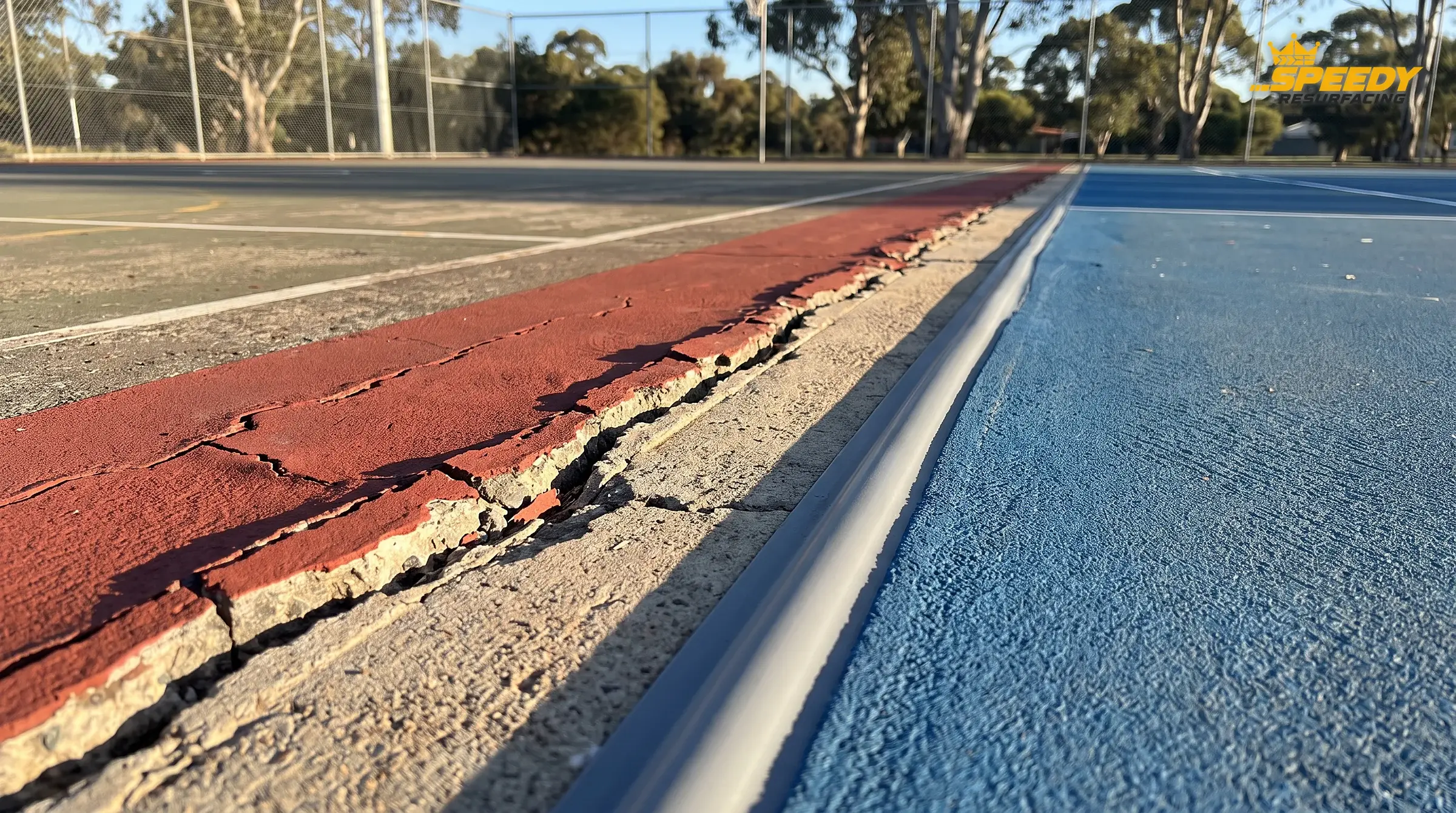
Thermal expansion joints in concrete slabs or joins in asphalt pavements must be handled carefully. Overlaying rigid paint directly across an active expansion joint will result in surface cracking within months. Specialised flexible joint sealants are applied to accommodate structural ground movement beneath the play surface.
Can Netball Share Space with Basketball? (Multi-Sport Design)
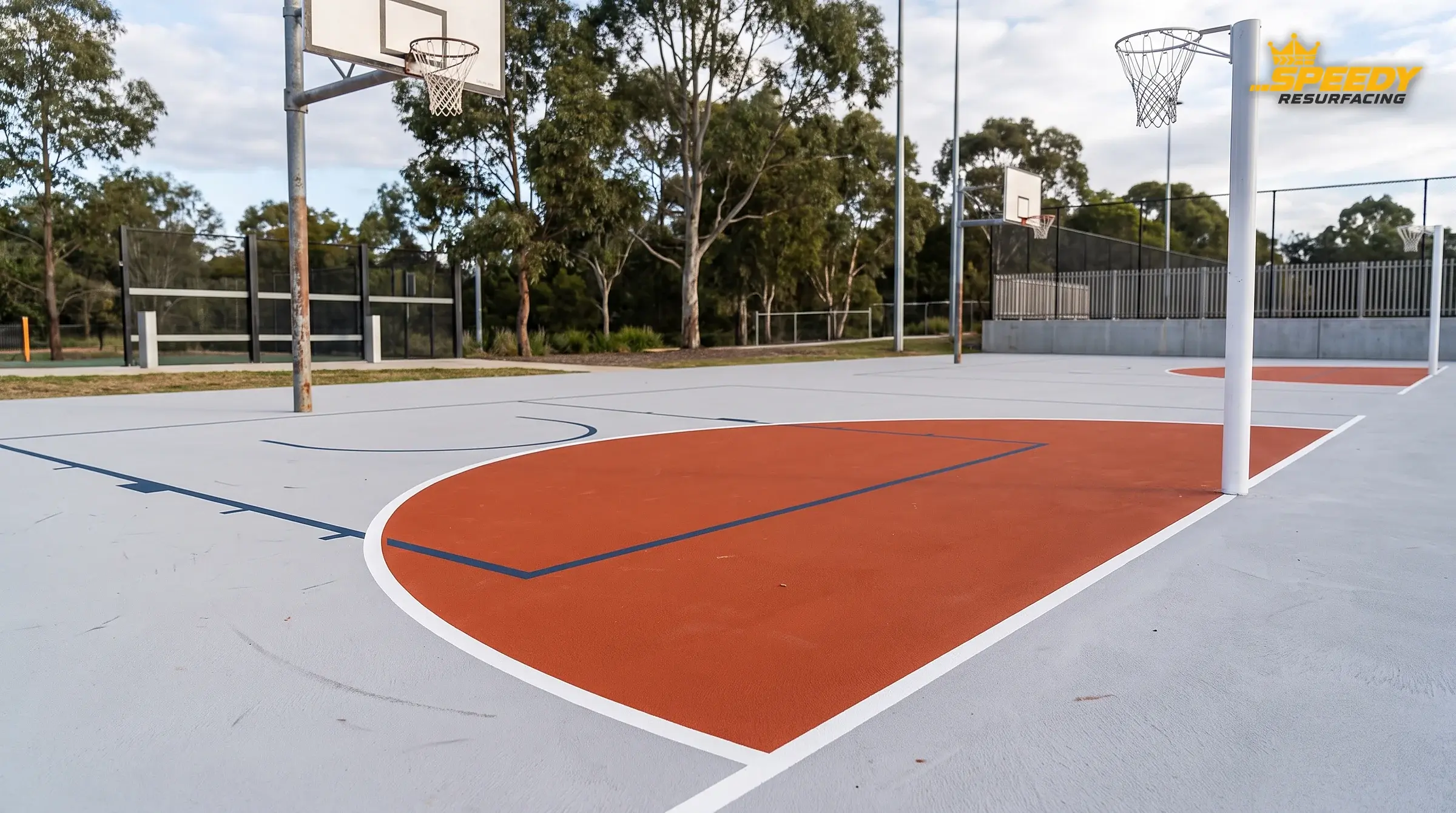
Combining netball and basketball onto a single court surface is a cost-effective solution for Sydney schools, community centres and strata facilities. However, dual-sport marking requires careful visual planning to ensure legibility during game play. When combining sports, line hierarchy dictates how the court is visually interpreted:
- Primary sport lines: Applied in 50 mm width using high-contrast colours, typically white or yellow.
- Secondary sport lines: Applied in 38 mm or 50 mm width using distinct, non-conflicting tones such as navy blue, light blue or red.
- Colour-zone differentiation: Contrasting solid colours for the basketball keyway versus the netball goal circle allow players to instantly distinguish boundaries without line confusion.
Resurfacing also allows facilities to replace old, faded single-tone concrete with modern multi-colour schemes. A popular layout involves selecting a deep green or blue for the main playing court, a contrasting shade for the surrounds and solid accents inside the netball goal circles. Premium acrylic resurfacing systems use UV-stable pigments that resist premature fading under harsh Australian sun conditions.
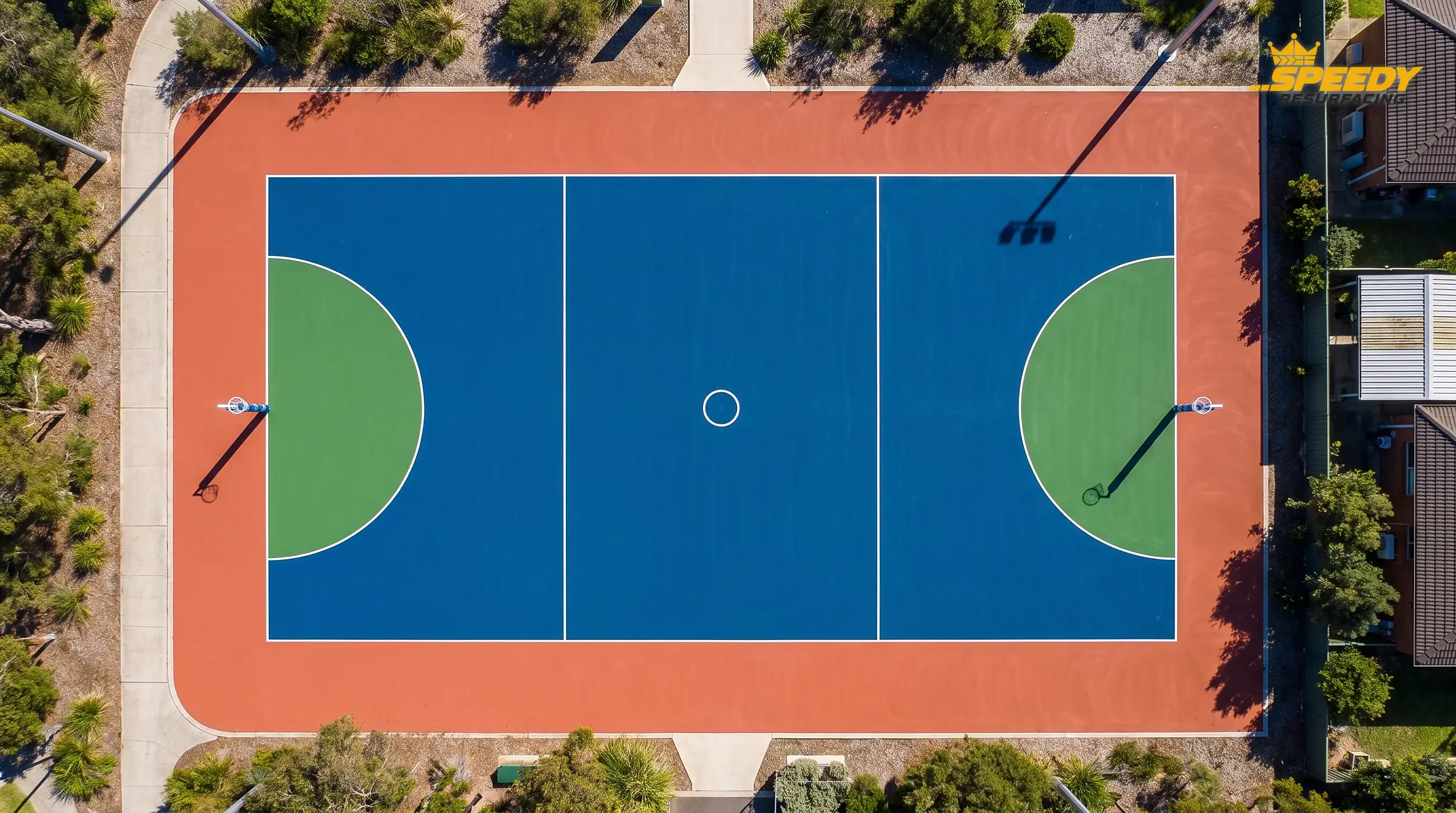
Netball has no slide. Every stop, every pivot, every landing is a contract between the shoe and the surface — resurfacing is how that contract gets honoured.
Speedy Resurfacing
The 6-Stage Professional Resurfacing Process
Court resurfacing is a structured surface-engineering procedure. Executing a professional sports court restoration with Speedy Resurfacing follows a rigorous six-stage methodology to ensure long-term durability, optimal traction and strict compliance with governing standards.
- 01
Diagnostic inspection
Evaluating substrate integrity, testing moisture levels, checking slope drainage and measuring goal-post alignment.
- 02
Mechanical grinding & preparation
Heavy-duty surface grinding removes failing paint layers, smooths surface irregularities and cleans microscopic pores to guarantee mechanical adhesion.
- 03
Structural crack & ponding repair
Structural cracks are cleaned, routed and filled with polymer-modified acrylic binders. Low spots holding standing water are levelled.
- 04
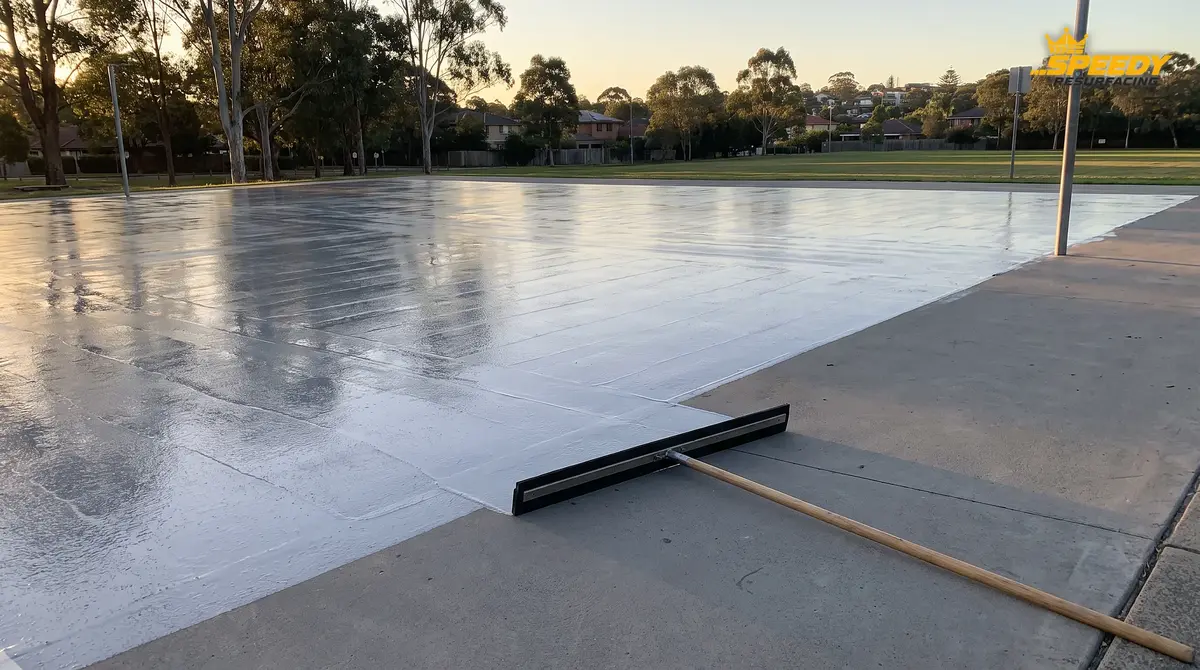
Adhesion base coat application
A high-penetration acrylic bonding agent is squeegee-applied to bind the concrete or asphalt sub-base to the incoming colour system.
- 05
Multi-layer UV acrylic coating
Multiple heavy-bodied acrylic resurfacer coats impregnated with silica sand build matrix thickness, flexibility and anti-slip traction.
- 06
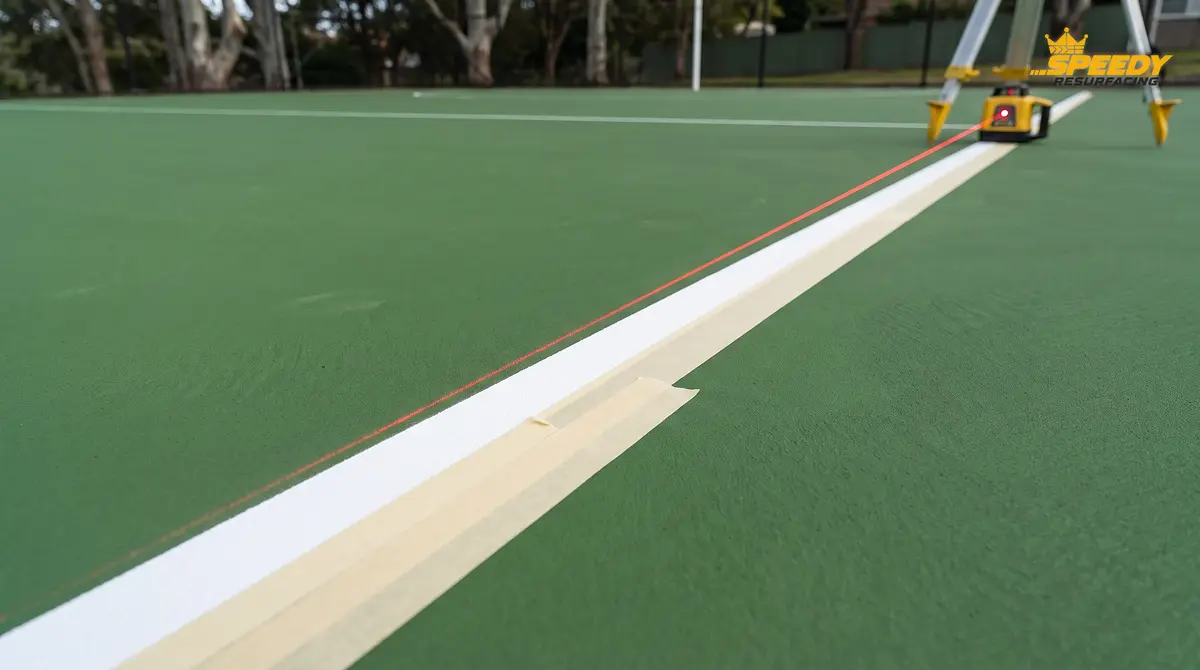
Laser-guided precision line marking
Taping and painting sharp, regulatory 50 mm netball lines in durable, non-glare line paint compliant with governing standards.
Arrange a Professional Netball Court Assessment
If your netball court surface is slippery, faded, cracked or holding water, a professional resurfacing system is the most durable, cost-effective way to restore safety and performance without full concrete reconstruction. Leave your name, mobile and email below, call 0466 495 495 or email info@speedyresurfacing.com.au to schedule an on-site court inspection and a detailed proposal tailored to your facility. Speedy Resurfacing is the specialist court division of Speedy Line Marking.
Frequently Asked Questions
Know a school, club or court owner who needs this?
Send them the article in one tap, and follow Speedy Resurfacing on Instagram @speedyresurfacing and Facebook for before-and-after court transformations across Sydney.